Thursday, 18 April 2024

The Lucky Shag


I'd previously been advised by a friend who visits Perth fairly frequently, not to miss the Lucky Shag pub. Not that you can miss it really, as it sits in a prominent position at Perth's river front, just where all the cruise boats set off from and return to.  So, having just returned to the river front from a cruise, it would not have been easy to miss as we more or less disembarked into it.  The ornithological amongst you will gather it is named after a seabird.  Those of a dirty mind may not.

This is quite a big pub with a very large river terrace which was well filled by workers enjoying a post work happy hour drink.   Incidentally, in most parts of Australia, happy hours between five and six o'clock are common. Sadly, very few seem to move much outside that time, though we did find the odd one, so best find one you like at six and settle in. The format varies. Some offer reduced prices on certain drinks or all of them, some give a pint for the price of a schooner and so on.  Some don't at all.  I think in this case it was around 3 dollars less for a pint, which was the most common measure in Western Australia, I'm told this is because of the proliferation of Poms in that neck of the woods.

So, a pint it was.  The unfamiliar nature of the beers had me settling for a locally brewed pale ale, Nail Brewery Pale was hazy and tasty in the New World style. At 4.7%, it slipped down well. E began her on/off love affair with Northern Crisp as we chatted to our travelling companions and watched the very busy staff fly up and down the bar. Our hotel was only a reasonable walk away and had a sort of Irish Bar next door, where we ate and finished the night off. It didn't seem very Irish to me, but given that it was called Fenians, I guess that was the kind of clue as to the aspiration if not the actuality. It was a decent enough pub though and there, usefully, I realised that I don't care for James Squire Lashes, a beer which seemed to crop up everywhere.

I also learned in Perth that Castlemaine XXXX is still a thing, that every bar has an XPA (Extra Pale Ale - An Extra Pale Ale is a beer style similar to a Pale Ale with a larger amount of pale malt than a conventional Pale Ale, which gives the beer a paler, brighter colour and crisper flavour) and that draft alcoholic ginger beer is very much an Australian thing.  I also increasingly observed - and this is a very good thing - that hazy beers are very much the exception, but available.

So, how much does it all cost? Despite being ticked off on Twitter by the Beer Police, I can reveal that pints were generally around AUS$13/14, with schooners being nearer $10.  There were more or less two dollars to the pound, so broadly halve it. This did vary, but two schooners could be relied on to be around £11 though like anywhere, it varied.

No worse than London or even Manchester City Centre pricewise really.

We returned to the Lucky Shag the next day and enjoyed a bit more room, but this is one busy and friendly pub and very much worth a visit.

 As I go through this sojorn, we'll learn a bit more about Australian pub culture, some great pubs to visit and beer measures. (Which aren't as striaghtforward as you might think.)

Wednesday, 17 April 2024

A Pub With No Beer

Oh it's lonesome away from your kindred and allBy the campfire at night where the wild dingoes callBut there's nothing so lonesome, morbid or drearThan to stand in the bar of a pub with no beer
 
Lyrics - Slim Dusty 


Well, you have to start somewhere with your first Australian pub, don't you?  In my case, it was in Fremantle, the port city of Perth in Western Australia. A neat little town I observed as we trundled through it on our tour bus on the first full day of our Australian adventure.  Now, being on a guided tour has advantages and disadvantages. You do get to see things you wouldn't otherwise see. Of course the flip side of that, for the dedicated beer man, is staring disconsolately at very fine pubs or breweries you'd nip into in an instant should we perchance stop to examine a nearby view or statue. Thus, Little Creatures fine brewery and Tap Room came and went as we sailed past. It looked good. 

We did stop though in a small park just outside the main drag, and being unsure of the score cash and card wise, and processing no Aussie dollars we spent 20 minutes of the allocated 45 minute stop seeking a cash point.  We decided therefore that the nearest pub to the departure point would have to do and the boozer itself, the Ball and Chain didn't look bad at all, with its colonial style verandah and corner location.  Inside was a fine wooden floored open plan building with a large bar and a couple of rooms off. At around two in the afternoon, it was pretty much deserted, but it would do.  I surveyed the unfamiliar pumps, and before I could decide, the barman, somewhat morosely, pointed me to a notice. "All Tap Beers are Out of Order". What?  It transpired that there had been an electrical fault in the cellar and all draft beers were off. This was accompanied by a jerk of his thumb to a well stocked fridge full of cans.

I nipped back to the seated E to explain. We had no time to go elsewhere, so a couple of reassuringly expensive cans were bought for cash, as we now had money. Others from our coach wandered in. It gave us a chance to get to know them and in fact the beers chosen were local and very good, but it wasn't a great start to Australian boozing.

Our next excursion was a Swan River cruise back to Perth, where things looked up at a really great pub just where we disembarked. I had previously been advised not to miss it, so we didn't.

In fact, I had been drinking Little Creatures in the Qantas Lounge at Singapore's Changi Airport, so I didn't miss out entirely.

Next: A Lucky Shag.

Friday, 9 February 2024

Let's Pay More for Cask?

Now we all know that the way to save cask beer from its inevitable demise is to charge more for it, don't we?  Well no. Of course not. Well, not in the general sense anyway, though of course there are exceptions.

A couple of weeks ago I read with a sense of disbelief that yet again this daft idea gets prominence in trade news, this time as it often is, in the good old Morning Advertiser. Georgina Young, Head Brewer at St Austell, in an opinion piece, tells us that a "dedication to quality would mean less chance of a poor pint". Well, that is surely obvious, but we all know that's not how it is, don't we?

Georgina doesn't expand her arguments much in the article - though that may well be due to editing - but let's rehash some of them. These are based on various open sources about premiumisation, adapted to the cask conditioned beer situation:

* premiumisation could be a strategy to enhance the perceived value of this traditional form of beer, potentially leading to increased sales 

*cask conditioned beer is typically associated with craftsmanship and authenticity. Highlighting the artisanal nature of the brewing process, the use of traditional recipes, and the dedication of skilled brewers can create a narrative that appeals to consumers seeking authentic and unique experiences
 
* using premium and locally sourced ingredients or speciality malts and unique hops, can set cask conditioned beer apart from mass-produced alternatives
 
* educating consumers about the distinctive characteristics of cask conditioned beer, such as the live yeast, natural carbonation, and serving methods, can enhance their appreciation and educating consumers about the unique aspects of cask beer can create a premium perception
 

The theoretical outcome, in this scenario, is that by employing these strategies, breweries can enhance the premium image of cask conditioned beer, attracting consumers who are willing to pay more for a unique and high-quality drinking experience.

On the other hand, there are decent arguments against: 

* if the cost of cask conditioned beer becomes significantly higher, it may alienate a portion of the consumer base that is price-sensitive. This could limit the accessibility of cask conditioned beer to a broader audience

* some enthusiasts and traditionalists will argue that the essence of cask conditioned beer lies in its historical roots and accessibility. The perception of exclusivity and high prices may be seen as contrary to the traditional values of cask ale, potentially leading to resistance from those who appreciate its historical and communal aspects

* the existing consumer base for cask conditioned beer often values its affordability and accessibility. If premiumisation strategies are not carefully managed, there is a risk of alienating loyal customers who appreciate cask ale as a traditional, everyday drink

* premiumisation relies on creating a perception of higher quality, but there is a risk that the perceived value may not align with the actual improvement in quality. If consumers do not perceive a significant enhancement in taste or brewing craftsmanship, they may feel that the premium pricing is unjustified

Now, you won't have to be that astute to guess that my sympathies, by and large, lie with the second set of bullets. It is perhaps the last of those, though, that really hits the nail on the head.  You have to get the quality right, and really there is a fat chance of that given that there is a wide and diverse range of outlets for cask beer, from the specialist supplier to the lone dusty handpump sporting a Doom Bar pumpclip. You have token cask beers, indifferent cellar keeping, differences between brewery outlets and those of pub companies and more. In the diverse pub market we have, you can't simply wish premiumisation upon it, bump up the price, and hope people will cough up.

Already in some specialist outlets that premium does apply, and it applies for the simple reason of trust. People will pay more for the certainty, especially if quality is poor elsewhere.  The other point that should not be forgotten, is that cask beer is a live product. Usually in premium situations, you price an object higher, but sell less at a greater margin. But pesky old cask doesn't lend itself to this arrangement. It goes off if you keep it hanging around.

So, is premiumisation dead in the water? Will cask continue to be the cheapest beer on the bar? It kind of depends doesn't it. In theory, quality always sells, but implying that premium pricing can apply to the whole market is misleading. Nobody really wants to spend top dollar on a gamble. Georgina agrees with this, but draws a different conclusion as to the solution. Baffling really as you have to achieve the quality. If you have the market, skills, quality and turnover, by all means bump the price up. In fact, why aren't you? Probably because you realise the beer has to shift. It is a kind of circular argument.

As I see it, logically, with minor variations, the old rule still applies. Cask beer has to be priced to go. That rules out premiumisation in very many cases.

Of course, prices of cask beer vary. Competition, and quality, make for cheaper beer in the parts of the North still  dominated by cask. The market still decides.

London has bumped up all beer to an eye watering extent, such that even Wetherpoons are now offering £7 pints, albeit, not cask. Well over a fiver is very common and over six not rare.  Not sure that's premiumisation though.

Tuesday, 30 January 2024

Part of the Union

I heard recently of Union Street in Bermondsey as being a place worth a visit. Fortunately, E knew exactly where it is so following her directions, we had a pleasant walk across the Thames until I pointed out we seemed to be getting further away from it. Now it seems that the version of Google I was using could not be trusted in this matter. So after E consulted her much wiser version, we retraced steps and eventually found ourselves on Southwark St. There it was, just round the corner, as presumably it has always been.

Back a million years ago, my trade union was based in Southwark St, but I had never had a reason to visit it, but I could remember that they all used to go to the pub nearby. What was it called? I couldn't recall, but once again, fortune favoured me. We spotted the White Hart - that was it - and it looked very pleasant, but being a Fullers house, it wasn't what I had in mind, but later, we sort of wished we had called in.

Our first port of call was the Union Jack, quite a pleasant looking pub with long, large windows and rather an appealing inside. Quite old-fashioned, I suppose, but in a good way, and the welcome from the barman was genuine and warm. A sole, dusty looking handpump sported a St Austell Tribute clip on it, but we weren't taking a chance on it. A pint and a half of fairly ordinary Camden Hells was ordered - is it me or is this getting a bit rarer? -  and we enjoyed the visit. I feel being busy, which is certainly wasn't, would have cheered the place up no end, but it was fine, and the welcome made up for a lot.

We ignored the Charlotte just over the road on account of its Heineken sign and went into the rather unlikely looking Lord Nelson. Now, you couldn't accuse this eclectically decorated pub of being quiet. A very young clientele were filling the place, many wiring into hefty plates of fried food and burgers. The food looked fab and I quite liked the place, even though clearly we weren't the target clientele by several decades. Sadly, the rude barman, who was just finishing his shift, wasn't paying the least bit of attention and I had to repeat my simple order of a pint and a half of Camden Hells. I tried to engage him, but clearly I was wasting my time. He promptly thereafter went off duty and removed himself to haunt the other side of the bar. Ageist I wondered? Possibly, but I'm happy to give him the benefit of the doubt and allow he had just had a long shift. Either way, I honestly liked the place, recognised its attraction to others, and as a bonus the Camden Hells was a large cut above its neighbour's. E on the other hand couldn't wait to get out. So, I'd say visit, enjoy the vibe, but only if you are under thirty or are immune to feeling out of place if you aren't.

Of course, even in a small pub crawl such as this, you have to pick a favourite. Heading back to Borough Market and the 343 over the river, we nipped into Mc & Sons. This is an Irish style pub - without the umpteen intrusive televisions - and was severely rammed with after work drinkers.  Nonetheless, the service was swift and cheerfully efficient, but it was so busy I could see little of the bar. I'm pretty sure there was no cask and I wouldn't have had it anyway here, as everyone seemed to be guzzling Guinness.  If you can't beat them, join them is sometimes not a bad motto.  The Guinness was the best I have ever had in London. Perhaps a tad cold, but certainly the best since I was last in Belfast, and at least a match for Mulligans in Manchester.  

So we had another. Seemed the right thing to do, especially since the same barman who'd served me, when collecting glasses, saw us standing in a corner and shifted some office workers who'd purloined the table that should have been there.  Thus seated, we enjoyed the busy scene even more.

We left with considerable reluctance, but we will be back. As always.  "It's the offer, Stupid."

We nearly had a third drink, but it was Burns night, and haggis neeps and tatties in our local JDW were calling us.  That was rammed too, and the staff did their best, which really is all you ask of them.

I had hoped as mentioned in an earlier post, to tell you of the Sir Sydney Smith, but that, alas, must wait.

Thursday, 25 January 2024

A Few London Observations

 I'm a bit of a creature of habit when I come to London. First night, check the flat is in one piece then off to the Aldgate Tap for a few pints, followed by a quick visit to get one of the few pizzas I ever eat at Pizza Union. Vesuvio of course.

Thus, it was on Tuesday. Flat in one piece - check. Aldgate Tap - check.  Now this is one of several taps, mostly near railways stations. In fact, we have two in Manchester and soon to be three, which is a bit of a secret, but I can make a guess as to location as I've been told it is a station. I know Jon, the owner, and he runs decent boozers at reasonable prices. I know the manager of the Aldgate Tap too, and he came over to have a chat and ask how the beer was.  Kelham Island Pale Rider was my choice of the two casks on offer, the other being Taylor's Golden Best. Both were under a fiver, and we spent a few minutes chatting about the pub, trade, and of course sparklers. All very pleasant, as was the pizza. 

The Aldate Tap is a peculiar building in Aldgate Square, all glass and metal, with a large outside area, which is fine, but draughty in winter with all the comings and goings. There is a good range of keg beers, and even Guinness, though my eyebrows were raised at the £7 a pint price. Better to have Rothaus Pils at £6.60 a pop in my view, but at least you can be sure the cask is in good nick.

Yesterday, in an effort to have a change, we walked to the National Portrait Gallery, which took just under an hour. My replaced knee took it in its stride - see what I did there -  and after a good look round  - highlight Rabbi Robert Burns and Mo Mowlem -  we decided on a local pint before heading to our destination in Gloucester Road for Lebanese scoff at Baba Ganouj which had been recommended.

 Now, Sam's Chandos is virtually opposite the National Portrait Gallery, but a quick look in revealed it to be virtually deserted, so in search of a better atmosphere, E suggested the Harp. And why not?  It was fairly quiet too, but even so, I have to mention that my cheery hello was ignored by the server, who was much more interested in his phone. Not something I appreciate, nor do I approve of the card machine being thrust under my nose without being told the price. The custodian of the bar seemed put out that I asked much it was, before turning the machine in a way I could read it. All wordlessly. He wasn't a lot better with customers, who on the way out thanked him. No response being his reply.

Maybe mine host had got out of the wrong side of bed or something, but it was an annoyance I could have lived without. Fortunately, my pint of Harvey's Best was on very decent form, which mollified me somewhat, and E expressed contentment with her Dark Star Hophead. But we didn't stay for another, despite the quality of the cask beer.  To spite him, I didn't take the glasses back either, as is my custom, but E did, insisting that we at least have standards. She's a good 'un.

And so to posh Kensington. The area around Gloucester Rd tube is rather agreeable. We spotted the restaurant, spotted a decent looking pub almost next door and with time to kill before our booking, decided on a stroll round before a pint. There is dosh in that area, and we enjoyed the to-ings and fro-ings, as posh parents picked up posh children from school and the general atmosphere of rich people about their business.  We walked a half mile or so, until a pub hove into view.  It looked fine, but the Greene King plumage didn't auger well. The Gloucester Arms is an imposing street corner pub. Inside was rather plain, but you could see in its day it would have been rather grand. Still decent now, with quite a few people in, though in fairness I didn't imagine them in the nearby mansions and mews houses, but perhaps I'm being unfair. The sole barmaid was pleasant and patient as we hummed and hawed, having dismissed the only cask beer, Greene King IPA. I chose Brixton Lager which was harmless enough, and we enjoyed a bit of people watching. The same barmaid smilingly thanked us when we brought our glasses back. See? Not that difficult, Harp.

The Stanhope Arms promised a selection of cask ales, but alas there was only Greene King IPA and maybe Abbott. I say that because the place was rammed and the bar hard to see. A very mixed crowd, with students, older couples, people coming straight from work and the like. It was very jolly and we enjoyed it. For me Portobello London Pilsner and for E who has a deep distrust of local lagers, Estrella, which I think comes from Bedford.   Two things of note. Firstly the tables, a mix of high and low, were so crammed together that any movement involved a convoluted exchange of "excuse me" and "sorry" as folks arrived and departed, or simply tried to go to the bar. The other thing was that in the hour we were there, not one pint of cask was sold. But we liked the place a lot, and that is not to be overlooked. The staff were cheerful and willing too.

After a fab Lebanese meal - you really ought to go there for the real thing and smiling cheerful welcomes and service - we headed home. Beer was out of the question as there was simply no room left, but we thought why not go to the Dog and Truck, which is probably our nearest pub, though equally it could be the Brown Bear or the Princess of Prussia.  Alas, our anticipated nightcap of a glass of verdejo was ruled out as the place was closed. Ruling out the Brown Bear (a bit rough for E) and the Princess of Prussia (bloody expensive), we headed to the excellent - why don't we go there more often? - Sir Sydney Smith - where decent wine at a good price was procured and the atmosphere enjoyed. More of this soon.

So, in summary, the much lauded Harp had the most indifferent service, but the best beer; outside known places cask is in deep decline; and even the most unlikely pubs had a decent welcome and service. Make of that snapshot what you will.

I'd observe from Brixton lager and Portobello Pilsner that the brewers really need to put a few noble hops in their beers to give them some character. Both tasted more or less of nothing, and whoever thought that heavy handled glass with a thick rim, was a good idea for Portobello Pilsner, should have a quiet word put in their ear.

I walked over 16,000 steps. Not too shabby. Oh, and price? Expect nearly a tenner for a pint and a half of anything.

Friday, 19 January 2024

Baby, It's Cold Inside


In these difficult and expensive - and it has to be said this winter -  bloody cold - times, it is rather pleasant to leave the dank and chill of our underheated homes and head for the conviviality of our nearest pub. How satisfying it is to turn the heating down, head for the door and spend the saved money in a venue where the price of your chosen drink includes you being nice and toasty while you sup your amber nectar.

Or is it?  The problem of affording heating at home, alas, cannot with certainty be avoided by jumping ship to your nearest boozer. Like Doc Morrissey in the Fall and Rise of Reginald Perrin, you may well find that they have it worse.  You see, unlike us lucky sods at home, who have at least some limits applied to our energy supply, your local pub is entirely subject to the vagaries of the market and the various commercial contracts that they have entered into. In short, the price of heating pubs has gone up considerably.

Recently in the cold weather, I have noticed some pubs, quite frankly, to be more than a tad chilly.  Now this is a problem. Nobody likes a cold pub, and not many of us will sit in one for a long time. Being cold when out spending your hard-earned is hardly an agreeable experience, and while it isn't difficult to sympathise with the situation pubs find themselves in, it is yet another disincentive to visit. We have quite a few of those already.

Yesterday in Manchester, two out of the three pubs I was in while celebrating my 25,000 days alive - I won't be doing that again - were actually cold.  So cold in one that my wife refused to allow a further drink, as she was perishing. In this case, it was not helped by a door at the rear to the courtyard was left open by smokers as they nipped in and out. With a door at the other end admitting customers, it made for an icy through draught from the sub-zero temperatures outside. While the radiators were feebly doing their best, it was a losing battle, and in any case they didn't seem to be that hot anyway. Our earlier experience in a very large venue wasn't much better, though they did have a huge space to heat, nor was the small restaurant where we tried to enjoy a meal. I'd call that a trend.

So, what's to be done? Well, hard to say. Pubs could put prices up, as I, for one, would rather the drinks cost a bit more than be cold inside the pub. They could also ensure that their pubs are as draughtproof as possible, but whatever, in a cold winter like this, something needs to be done.

For me, I reckon if it is cold inside the pub, I'll just be voting with my feet and go elsewhere. I'm too old to be suffering over a pint.

It has to be said that you are less likely to encounter cold pubs in the managed estate of breweries and  of course, busy pubs do generate human heat, so a bustling and busy pub is also likely to be warmer.

Not much chance of warming up on the bus on the way home either. The shocking state of our buses makes a warm bus a real rarity

Friday, 12 January 2024

Best of Luck with That One

Hot on the heels of me writing about the difficulties some pubs are facing, causing them to operate on reduced hours, I read with a degree of astonishment that the number of applicants to run pubs is running rather high at the turn of the year.  It seems January is the peak time for this optimistic attitude, with, according to the good old Morning Advertiser, numbers up by over 50%.  As the MA puts it,“New year, new me.


"So often the cry of someone who managed to survive the previous 365 days despite facing hammer blows all the way, with the intention of reversing such misfortunes in the time it will take for the Earth to revolve around the sun again."

Well, it may well take longer than that if the current difficulties facing the trade are anything to go by, and while it is good to see prospective pub operators - both buyers and sellers - looking on the bright side, it would seem to this writer that it somewhat flies in the face of how the economy is faring now.  Of course, good sites and pubs - and there are some - will always attract interest, but I wonder just how much of this activity is at the wet lead end of things, and how much is in the more deprived areas of the country.  

The companies quoted are Admiral Taverns, Marstons, Greene King and Star Inns and Bars (aka Heineken), who are particularly keen to emphasise that around £4000 can get you started.  Heineken are also happy to say their new model means less risk (for them). How do they do this? Easy. They tell the MA that they buy all the products and set all the prices.  That's all right then, isn't it?

If you feel inspired, the article is here. Don't all rush at once after reading it.

The Morning Advertiser is always worth a read, though you have to register after two articles.

I notice, too, that Stonegate Pub Company with 4500 pubs and 19,000 workers is seeking to refinance £2.5 billion worth of debt. Pub companies are always a worry.

Thursday, 11 January 2024

Opening Hours Erosion. Good or Bad?

In the world of hospitality, pubs have long been regarded -  probably through rose-tinted glasses -  as communal hubs where friends gather, strangers become friends, and general relaxed jollity ensues. However, in recent times, there has been a growing tendency for pubs to close during quiet business periods. Outside city centres, it has become increasingly difficult to find a wet led pub that is open at lunchtime, never mind one that is bustling.

 Managed houses, with a food offering and salaried staff rather than part-timers are likely your best bet, though these may be a bit too restaurant like for the casual drinker.  It is particularly noticeable that pubs run by tenants often see little point in opening the doors just for the odd one or two punters that might wander in and stretch a pint for a couple of hours. In fact, increasingly, days like Monday and Tuesday are often being written off altogether. This shift in perspective challenges the traditional notion that pubs should remain open at all permitted hours, and highlights the dilemma for pub owners and the effect on the community at large. 

Running a pub is a pretty hard game these days, especially when it comes to juggling costs and earnings. Lots of places end up staying open when things are slow, which means more expenses - heating being a prime example. Shutting down during slow times seems like a sensible way of overcoming this. It helps pub owners make the most of what they've got and build a business that matches the actual number of people coming in.

The logic is quite a simple one: closing the doors during quiet periods allows pub owners to reduce operating costs significantly. Energy consumption - a huge overhead these days -  is decreased and staff wages reduced. By strategically closing during these hours, owners can better match staff to demand, and thus operate more efficiently. Getting opening hours in synch with likely footfall is also good for morale, as it were, as there is little more soul-destroying than overseeing an empty pub as the clock slowly ticks away the pointless hours. 

Hopefully too, focusing efforts on the hours when customer footfall is at its highest can also make for a better customer experience, as after all, who wants to sit in a miserably empty pub? Customers make for atmosphere, and the lack of it does not encourage a lengthy stay. Concentrating efforts and resources on peak business hours, can - or here I'll say should  - ensure that the service, atmosphere, and offerings are of the optimal standard. It does not work at all if you simply take the same sad old offering and simply spread it over a shorter period. If you are going to open less, greater efforts have to be made to make the pub attractive when you do.  And above all, you need to ensure that potential customers know when you will be open. Even now, far too many pubs seem to think that opening hours are some kind of state secret that should jealously be guarded. Telling potential customers about opening hours and what's happening in the pub is not a bothersome extra. It is an essential part of the business.

While the idea of closing pubs during quiet business periods may seem a bad idea at first, it can be an acknowledgement that times have changed and cloth must be cut accordingly. By embracing a more strategic and efficient operational model, pub owners can create a sustainable business that benefits both their bottom line and the customer experience. 

In the end, finding the right balance involves satisfying customer needs, while also securing the enduring sustainability of the business in a constantly changing market, but it does look as though reduced hours are here to stay and ultimately, better than the pub closing altogether..

Wednesday, 3 January 2024

What's Going On?

At this time of year, one becomes introspective. Resolutions are made and lives, intentions and hopes are re-evaluated, usually in an optimistic and entirely unrealistic way. Such thoughts equate entirely with our human need to see the best of things - to look for hope, change and better outcomes - this, despite all the evidence that a new year and promises to oneself, rarely if ever change the probable and probably inevitable course of events. It is all pretty hopeless in that sense, but then again, we live in hope. It is the meaning of life to a very great extent.

Thus, I won't be making impractical promises about this blog, though my own promise to myself is that I'll try to write more, but I'll likely fail. Instead, to make it easier on myself, I'm looking to write more about things that might interest me. And guess what? It is, funnily enough, going to be beer and pubs, so that's all right, isn't it?  I know a bit about them.

Last year, having wasted many mornings of my life watching YouTube -  though almost never about beer - I definitely need to pack that in.  I have though watched from time to time, usually shouting at the telly in sheer disbelief, the inane Real Ale Craft Beer Channel, and I have also learned a lot of useless stuff - mostly about London Underground (fascinating) - the differences (many) between us and these goddam Yankees - and where to get the best cooked brekkie in London. (Widely thought to be Pellicci's - been there - but it would almost certainly be cheaper at the Ivy, though you won't get bubble there).   And so on.  So it is back to beer.

So what has been happening? Well things are still iffy in the industry to be frank, though maybe they could be worse.  I note record turnover from my local brewery JW Lees and that's good. Lees continue to invest heavily in their business and it shows. They deserve to do well, by and large. I see also Fullers and Youngs are doing well, so that's good, though London, as always is a different animal to the rest of the UK.  Sir Timbo deserves a mention, and I'm grateful for this piece being pointed out by Cookie. It is rather well written and mentions the obvious fact - often overlooked - that he started off with one pub and now has over 800. If you believe in honours lists, it would seem to me that he deserves it, and as Mudgie always points out, it is a dependable company in an industry that isn't very dependable as a whole, and one where there is that oft talked about, but usually missing, social mix. Incidentally, making alcoholic drinks and pub visits affordable isn't "wrong" if you want to see pubs succeed.  Again from Cookie is a similar piece from the Guardian.

I'll leave it there for now.  The blog will certainly be back a little more often, and I'll be returning to short sharp posts like I used to. I've been reading a lot of my previous stuff, and you know, it isn't that bad. I recommend particularly my stuff on Sam Smiths, and I'll be resuming my trek round the ones here and those I visit in London. I'll also tackle the issue of what might be called "opening hours deficit".  I note quite a few pubs here, have simply closed for parts of January, and while understandable, it isn't really a healthy sign.

So. Watch this space, and Happy New Year to you all.

"Let me say, for the benefit of those who have allowed themselves to be carried away by the gossip of the past few days, I know what is going on. I am going on."  Harold Wilson 1969

Best beer of 2023? Acorn Gorlovka Stout.

Friday, 15 September 2023

Book Review - Cask by Des De Moor

The subject of cask conditioned beer is a complex and broad one and to tackle it, Des De Moor has written a comprehensive and extensive book about it. At 334 pages, it covers a wide array of beery topics, presented as a series of chapters with subject titles and a narrative about each. 

 Let's start with the introduction in which the author sets out his aims and objectives, which, broadly, are to describe the product and its history and to fill in gaps that may not be covered elsewhere. It's a big ask and a look at the bibliography and list of those spoken to or interviewed shows the seriousness with which the subject has been approached, and here is the first observation. This is rather serious book. Didn't all those interviewees have some good stories to relate as well as words of wisdom?

At the beginning of the book, the author, in his first paragraph, sets out why cask beer is "unique" and" unmatched by any other".   He concludes by quoting Mark Dorber, a cellarman of some repute, about what we'd lose if we lost cask beer, which is the joy of being in touch with something living.  These are both sets of wise words, and neatly and succinctly bookend the content between them, and are probably the most important sentences in the book.

In many of the following chapters there is an inevitable crossover to beer history and to the techniques of brewing and if you are not already familiar with the art of brewing, these will be of interest, as are the explanations of cask size, filling, returning and the many aspects that make cask beer different from keg or other beer.  The chapters on cellar keeping are meticulous in their accuracy and are recommended as pretty much definitive, though on the downside, may inadvertently give the reader the idea that cask is a much more complicated beast than it is, a possible problem if you are already inclined to think of cask as a difficult to deal with. Whatever your point of view, you will certainly learn a lot about cask beer from these chapters.

There are also strong chapters on what makes cask, cask, and cask beer styles, flavour and taste, though a tendency to over explain creeps in, for example by discussing at fair length beers that should never be presented in cask form.  (Though it is good to say that not all beer suits cask conditioning). 

Controversial subjects include unfined beer and acceptable levels of haze, but skate over the potential damage done to traditionally clear cask beer that gave rise to the doubtful response, often given to punters in the pub, "It's meant to be like that" even when that isn't so.  Rightly the effect of poor presentation is discussed and the difference between live beer and cask beer, which causes no end of difficulties within CAMRA and elsewhere is mentioned, as is the rise of craft beer and its inevitable effect on cask.  The chapters on food and cask beer outside the UK are probably unnecessary, and much of the history could do with a sharper edit. In fact, this is a theme throughout, as the book itself is probably overall a bit too long.

Moving on to recent history and the future of cask, while merger mania is discussed and the Beer Orders mentioned, there is little reference to just how far the cask beer revival had come in the late 1970s and 1980s where throughout the country, both regional brewers such as Greenall Whitley, Shipstones, Morland and many national brewers, particularly Allied (who set up separate cask chains such as Walkers on Merseyside and Holt Plant and Deakin in the Black Country) were pumping out vast quantities of cask beer. Others large brewers like Courage also produced cask in volume. With Independent Family Brewers still flying the cask flag, as they do now, the rise of lager apart, this was peak cask and more could be made of it in the book. 

Then cask beer was mainstream and most that drank it just thought of it, if they thought of it at all, as beer. Not cask beer, not traditional beer, but just beer. And peak cask continued until the Beer Orders separated pubs from brewing, with dire consequences for both cask and the beer industry; a separation which still casts a long shadow today. The author recognises this as the law of unintended consequences, but he could have expanded, to good effect, the devastating effect on cask beer production and subsequently on beer quality, the cost of a pint and much more. 

As I mentioned before, we get little by way of a look at cask beer from the consumer point of view. Where are the uplifting stories from pubs, brewers and importantly drinkers? While craft in its current form may be the younger drinkers' discussion topic of choice under railway arches, cask has always been the social lubricant of the traditional pub goer, to whom the beer is important as an accompaniment to fun, rather than the fun itself - particularly when you could simply ask for bitter, and depend on your local pub or brewery to supply you with a decent pint. What happened to these famous cask beers such as Bass, Ind Coope Burton Ale, Tetley Bitter, Boddingtons and more, that you could depend on?  We could have been told, and a few anecdotes and a bit of background would have lightened and balanced the book.

Referring to the future, there is the unanswered question that if cask is in dire trouble as production figures suggest, why does it thrive in, for example, the likes of Sheffield, Manchester, Liverpool, Derby, Nottingham - and even rural Lancashire and Yorkshire? Can we not learn lessons from them? The question is mentioned, but not explored, though one solution mooted strongly is that the answer to cask's woes is to charge more for the product. This unconvincingly overlooks the fact that brewers are the last to see much of any price increase, and that cask succeeds in the places mentioned, as do the many small brewers that supply it. Perhaps the cost of cask beer, however it is priced, is both a strength and a weakness? A dichotomy that will never be resolved?

These points, however, don't detract from this comprehensive book. It is a very valuable contribution to any beery type's library, and useful for those that want (nearly) everything they need to know about British cask beer in one place. What is perhaps missing though is the affection, romance, intensity and the human interactions that many would say is the hallmark of cask beer, but as a more serious look at the subject, it succeeds in bringing together, the technical aspects over the more ephemeral and nostalgic. 

Reviewer's note. This isn't an entirely neutral review. Where cask is concerned, I have skin in the game. After all, I have been supping it for nearly 45 years and stopped many a firkin going sour over my time.  Whatever happens to cask beer, it will see me out, thankfully!

Disclosure: My review copy of the book was supplied by CAMRA Books, from whom this excellent book can be purchased. (CAMRA Members discount is offered too.)


Monday, 19 June 2023

'ow Much?

Allegedly, at least, the title of this piece is what your typical Yorkshire native might say, when encountering a price which is unexpectedly high. (Elsewhere, in this sceptred isle, assuming you are British, a gently raised eyebrow would most likely suffice.)

I was in London for a few days recently and promised I'd keep a close eye on prices. Nowadays, this is fairly easy to do, as in London, and increasingly elsewhere, the default is for the server to tap some numbers into a machine, barely, if ever tell you what the damage is, and hand it to you in the expectation that you will just swipe your card. Now, I do like to have the odd glance at the figures, but I can scarcely remember saying "Oi Mate - are you going to tell me the price?" It seems likely then, I'm as docile as the next man, and end up just swiping and hoping for the best. A worrying trend if you ask me, but I digress as at least when you look at your bank statement, the truth is there for you to consider somewhat ruefully.

Prices of course vary, and here, as you can imagine, I'm talking about prices in pubs. Oddly, though, prices of beer, as often as not, aren't clear as you'd hope. It is not at all uncommon - yes, I'm looking at you Stonegate as a main culprit - to list the price of everything but beer on table menus.  Is beer pricing so volatile that it can't be committed to print? I'd have thought not, so what could the reason be for this omission?  There are laws of course about displaying prices, though I think these are rather loosely complied with generally and for sure can't be relied on, though again this varies and in most of the places I go to, the prices are out in the open, but when you go of piste, rather less so.

So given that London is a bit different, what would be an average price for our usual round, which is a pint for me and a half for E. In my case, unless I know the place well, or I'm just feeling wreckless, it will be lager for both of us. That will vary too, but in the Euston, Farringdon and Aldgate taps, a decent German lager - say Schneider, Ayinger and the like will be around the £6.20 mark with Rothaus about £6.50. I have to say, that given the quality here, these are pretty fair prices, as you can easily pay more for Camden Hells or Brixton Lager, which certainly haven't come very far, and in quality terms, to this writer at least, lag considerably behind. Additionally, prices are clearly displayed, which is as it should be.

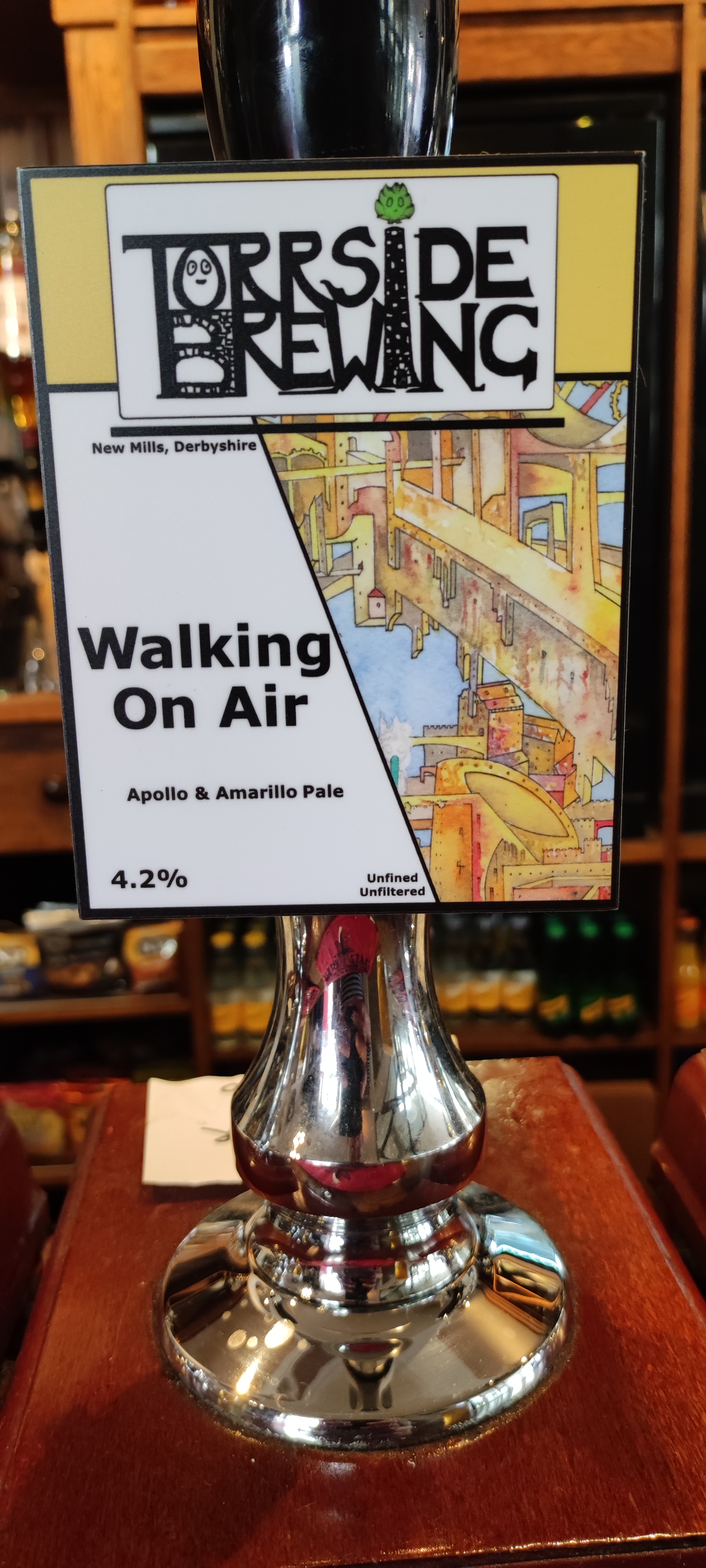
What of cask? Well, I did have some superb cask in the Sutton Arms. I think my pints of  Torrside were in the region of £5.70, as a pint of said beer and a half of Paulaner Lager for E was a reasonable £8.65.  Given the quality of the beer, I had no complaints at all. In the Waterloo Tap, en route to a do in Hampton Court, I had two excellent pints of mild from Redemption, while E had Schneider Helles for a reasonable £7.30 the pair. Not bad at all.  In Hampton Court, in the Prince of Wales, a rather indifferent pint of Triple fff Moondance - a former Champion Beer of Britain no less -  and a half of Spanish lager was £8.50, but we rather enjoyed the pub and all the rather posh denizens thereof, so that was fine. We were also soothed by the fact we were going to a function with a free bar at the birthday party we were attending.

Into each life, a little rain must fall, though.  Following a (very) late train from our evening out, we lurched into the Minories pub, which remains open after midnight but was pretty well deserted. £11.55 for a pint and a half of Camden Hells was somewhat shocking, especially when served in a floppy plastic beaker. This is a Stonehouse pub, which had many beers on, but no prices listed in the printed menu. (None of the other drinks seemed outrageous, though, so that's odd.)

So, is London particularly pricey? Well, on balance, given the higher overheads, probably not. You do have to pick and choose carefully to get the quality you want at a price that you are prepared to pay though. Overall the same round bought in Manchester might be a couple of pounds or so less, and in Rochdale, probably over £3 less, but is that really so outrageous?

As always, you pays your money and you takes your choice, though in London, you'd be well advised to put your choice into the equation first.

You will see I am a fan of the various Taps owned by Bloomsbury Leisure. Rightly so, in my view. They are currently developing on at Manchester Victoria and of course, already have the Piccadilly Tap. 

I was told at the Minories, it was a police instruction to have plastic, following an incident earlier in the week with over exuberant West Ham fans. Shame, and hopefully temporary. Stonegate also operate the Dog and Truck near our London flat. Same price problem with beer.

Thursday, 15 June 2023

Don't Roll Up - Queue Up

The tradition of buying at the bar and, if you feel like it, standing at the bar while supping your drink, is a long and honourable one. Passport to the Pub, published in 1996 by Kate Fox, a British social anthropologist, says of this:

 " Rule number one: There is no waiter service in British pubs. You have to go up to the bar to buy your drinks, and carry them back to your table"

She goes on to say, with particular regard to those more familiar with table service:

"Once they are aware of the no-waiter-service rule in British pubs, most tourists recognise it as an advantage, rather than an inconvenience. Having to go up to the bar for your drinks ensures plenty of opportunities for social contact between customers......... It is much easier to drift casually into a spontaneous chat while waiting at the bar than deliberately to break into the conversation at another table. 

Like every other aspect of pub etiquette, the no-waiter-service system is designed to promote sociability. The bar counter in a pub is possibly the only site in the British Isles in which friendly conversation with strangers is considered entirely appropriate and normal behaviour."

I recently tweeted this photo of a sign in Wetherspoons, which appears to turn this logic on its head. In no uncertain terms, it urges customers to "Keep the Bar Area Clear."  I said at the time it was most unpublike, and this caused a cascade of comments tending to agree with me, but as always, when commenting on JDW, a plethora of snobbishness about the chain were liberally sprinkled over the main point, including untruths about the company's attitude to Covid and its staff, as well as slurs about the type of people who frequent such dens of iniquity. Most unedifying, but in the main it was agreed this isn't the right thing to do. It is not a pub if you instruct people to queue up.

What I failed to do was point out which JDW this sign appeared at - and I have to say, I haven't seen it elsewhere.  When we first encountered the very busy area in which Tandleman Towers South is located, the area was much different. Almost derelict in many parts, and certainly the busy and bustling Leman Street was nothing like it is now.  The whole area was dead at the weekend and when the nearby huge Royal Bank of Scotland Processing Centre, wasn't at full tilt, the place was quiet. No pizza places, supermarkets, modern bars or brand new multi-storey flats, never mind the now sizeable student accommodation. You had to hop on a tube elsewhere for entertainment, though on the plus side, a few proper East End pubs hadn't yet been swept away. 

In that scenario, imagine our astonishment when a new Wetherspoons opened in the area.  In fairness, things were slightly picking up, but many a time we'd have a drink in the new Goodman's Field and wonder how stupid Timbo was in throwing his money away on what was clearly a white elephant.  Then, slowly but surely, the hotels started to open. There are now plenty from budget to mid-range, and the hitherto empty JDW began to thrive with each new opening.  Looking back on it, you can see why. The river and Tower Bridge are nearby, as is the Tower of London. There are tube stations and buses with easy transport for town and elsewhere.  Most may well offer food and drink, but not as cheaply as Wetherpoons.  Most of the visitors come from abroad, and I think it's fair to say that the majority of customers are not British. 

So, in this scenario, it is perhaps understandable, that a request to queue at the tills has been introduced to keep things simple for those who are just not used to jostling for attention at the bar, never mind facing the inevitable call of "Who's next?"   Yes, it annoys us Brits, especially those who have honed to a razor sharpness, how to get served in a busy pub first, but on the charitable side, it probably makes life easier all round, and to be fair, in my experience the rule is relaxed a tad when not so busy.

In this situation, perhaps Kate Fox would give a little wriggle room and forgive, as I do, this major transgression of pub etiquette.

Are Wetherspoon's many outlets really pubs? I think the jury is still out on that one, but not for the reasons above.

In the Goodman's Field, Kate's Rule Number two is often seen more in the breach than the observance: "It is customary for one or two people, not the whole group, to go up to the bar to buy drinks." Probably another good reason for the sign.

All rights to Kate's book are the Brewers and Licensed Retailers Association.


Friday, 2 June 2023

Fresh Ale? Neither Nowt nor Summat.

Every so often something comes along claiming that it will solve a particular problem. They come in many forms - superfoods which will give you a wet nose and a glossy coat if you eat enough of the right stuff - knee supports that fool the gullible into thinking that buying them will solve your bone on bone knee problems and obviate the need for surgery - that one got me - they don't - and so on and so forth. The simple fact is that when someone comes up with such things is that they rarely pass the smell test, so let's have a look at one that has recently come up in the beer industry.


"Fresh ale" is the latest thing, it seems.  What's that, you may well ask?  You may reasonably be thinking, "that'll be beer that is served before it gets too old" -  and why wouldn't you?  After all, they do this in some brew pubs where the beer is sold straight from conditioning tanks, so that'll be fresh, won't it?  Or what about cask beer - live beer served from a cask  - that has only a short shelf life. No, that's not it either, it seems. What about the initiative, launched only as recently as September by the Campaign for Real Ale (CAMRA) and the Society of Independent Brewers (SIBA) called Drink Fresh Beer?  This is "A campaign that recognises cask beer is in “steep, sustained decline” and is struggling to shake its “male, pale and stale” image will be launched at the Future of Cask Seminar on Thursday 22 September". That must be it then, surely? Well no. Guess again. It isn't that, either.

So what is it? It is a new keg beer, that's what. And you'll not be at all surprised to find out that it is "different and exciting."  What could it be, I hear you ask? Well, Drinks Business has the lowdown. It's a keg beer with lower carbonation, developed by Otter Brewery. It is explained thus:

"When we put it into a keg we actually low-carbonate it, so it has a much gentler and softer carbonation which is designed to emulate the carbonation of cask ale as far as taste goes in terms of mouthfeel. The second major difference is that when it is served, it doesn’t run through chillers in the cellar. Instead, it runs through the python or whatever assets the pub has to allow the dispense temperature to be around between 8.5 – 10℃. So, it is slightly cooler than cask ale, but it is not as cold as keg, and it is slightly fizzier than cask ale, but it’s not as harshly carbonated as keg".

Now at this point, rather than quote more chunks of the Drinks Business article, I urge you to read it for yourself, though I will offer comment on one more paragraph, and it is this: "CAMRA should be for it, not against it, he insisted.(The guy from Otter Brewery)  After all, “CAMRA now promotes ‘World beers’ which are in keg. If they are doing that, why wouldn’t they look at something brewed in the UK that is in keg and talk about it just as favourably?”

Now, of course, even a cursory read through this will have most readers thinking that there is nothing new here at all. This is just another keg beer positioned to fill and bridge the so-called gap between younger and older drinkers, lager and ale drinkers and traditionalist and modernisers.  We have been here before, and they have failed before. In Lancashire parlance, they are neither nowt nor summat, and will almost certainly be seen as such by the drinking public.

There is however another point.  It can and in this instance, clearly is, the case that in bending over backwards to "modernise" in an attempt to bring in younger drinkers to the cause, CAMRA is giving the impression to many, that real ale - cask conditioned beer - is just part of its mix rather than its reason to be. That is a dangerous position to be in. 

When the champion of cask conditioned beer appears to the trade and trade press to have a negotiable position on the subject, alarm bells should be ringing at CAMRA HQ.

The already weak case for this "breakthrough" is undermined by admitting the longer shelf life of this non-live product is a key feature. Otter also assures us that this is not a fad product. Let me know in the comments. 

Let's hope that if fresh beer is as relevant as it should be, that CAMRA and SIBA put some more welly into their original initiative. Cask beer may be suffering, but it doesn't yet need replacing with keg.


Tuesday, 28 March 2023

They Have Sam's in London too You Know

No doubt, my many readers are wondering whatever happened to my series of visits to Sam Smiths pubs.  In fact, I often wonder myself why I have not returned to this rich seam of pub culture and idiosyncrasy. Perhaps I have a small lingering doubt about Humphrey himself reading how the denizens of his establishments really conduct themselves, as opposed to how he wishes they would. It is also true to say that I have some slight concerns about how he may treat landlords and landladies, who, perhaps, in his distorted vision, would appear by my words to have somehow failed to live up to his expectations. On that point it is worth mentioning that in every Sam’s house I have visited, the managers have singularly, and with good humour, tried their best to honour Mr Smiths instructions, however odd they may be.

Of course, knowing myself, it may be that I just have been as usual far too lazy to get out and about and actually visit the 20 or so Sam’s pubs that are still open in my area. That number is of course an approximation, given that Humph has already closed more than one of the pups already visited and reported on – no doubt for some minor infraction of his somewhat arbitrary rules. But as always, I live in hope that one day, all 32 pubs in my Rochdale, Oldham and Bury area may all be open, and that some may actually sell Old Brewery Bitter in cask conditioned form.

But I digress from my original purpose. A couple of weeks ago, when in London checking that Tandleman Towers South still exists, we ventured into Soho with the intention of having a look at how some of the London Sam’s pubs operate. While it has never been officially confirmed, it is known that Humphrey's son Sam is the supremo of all the Southern operations. Things are done differently there, and while recently in the North, innovations such as paying by phone and card have been accepted, it is true to say that no such restrictions have operated in London for quite some time.The reasons for this are pretty obvious when you look at the clientele. I think it's fair to say that in the absence of paying by card or phone Mr. Smith would find insufficient customers willing to pay by cash, as payment by such is, in London, the exception rather than the rule.

Also missing from most of the London pubs is the plethora of notices forbidding this, that or the other, though it is fair to say that the one prohibiting electronic devices is generally clear and present, butparticularly in the case of phones, is blatantly and wholly disregarded.

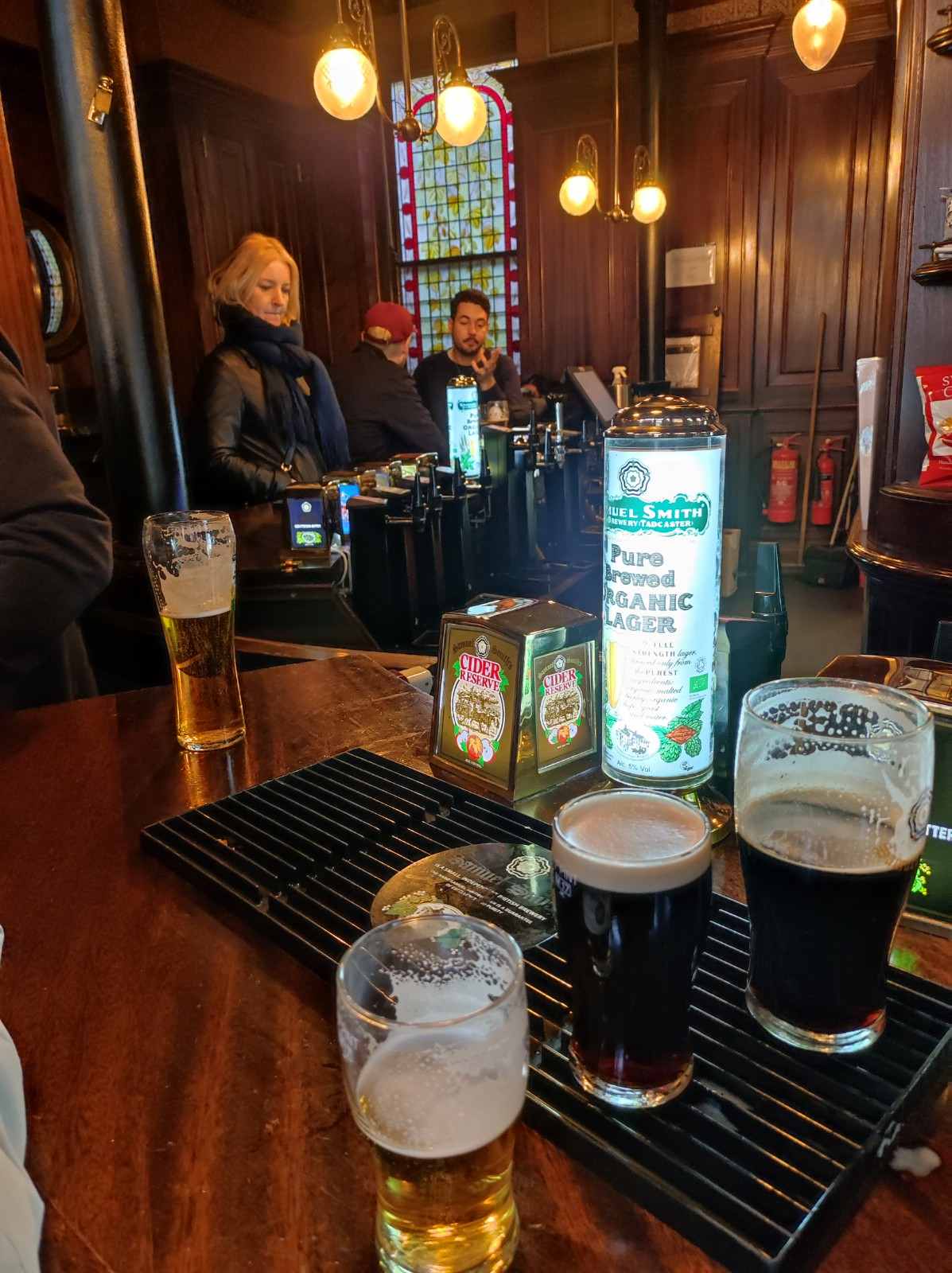
Our first port of call was the White Horse in Rupert St, more or less opposite the John Gielgud Theatre. It can best be described as a basic corner street local set out in typical Sam Smith dark wood, bare floorboards and a slight down at heel appearance. Old Brewery Bitter in cask format was available at £5.70 a pint, and was somewhat middle of the road in taste. E’s Pure Brewed Organic lager was an astonishing £6.90 a pint.  It is as well at this point to mention that Sam Smiths pubs in London are pretty expensive. Banish any thoughts of the cheap pint they used to be, and given the somewhat basic nature of some of the pubs visited, could be regarded as less than value for money.  The pub wasn't busy, but a steady stream of people wandered in, vaguely looked round and then blatantly zoomed downstairs to use the loos before re-emerging, pretending to consider drinks at the bar, before darting out the door.  At the bar more than one person sipped their pint while surfing their phone. The landlord, an Al Murray lookalike was clearly used to such behaviour and simply ignored all this while occasionally tilting his eyes in our direction.

Now, Sam's pubs are usually pretty good for people watching, but not in this case. The only real entertainment was a young couple, the male of which would occasionally lean in for a kiss, while the female would carefully move away. Fair dos, it didn't discourage him, and she happily allowed him to hold her waist. Likely she wasn’t keen on public affection, which is just fine. In fact, we bumped into them in a later pub and they seemed quite cosy. So, all was well.

Leaving this mayhem we walked a few steps to the Duke of Argyll, another Sam's pub but this time absolutely rammed.  This was a step-up in class. Multi partitioned, with each area jammed with customers, the lone bar person zoomed up and down at breakneck speed trying to keep up with demand. It took us quite some time to get served, and my pint of stout looked more like Coca-Cola. Clearly the nitrogen gas had gone, and subsequently the beer was poured as flat as could be. There was no opportunity to earhole the frantic barman, and frankly the poor bugger was doing the best he could. At last, when he had a second, I explained the problem with the pint and he offered an exchange. He took the opportunity in the meantime to call someone on his phone, who a few moments later emerged from upstairs to lend a hand. I suppose that was technically a breach of the rules too.

We struck up conversation with a guy who'd come up from Kent for the day. He turned out to be an ex-RAF type and we passed an agreeable half hour with him telling tales of avoiding customs duties from various tours of overseas duty - a subject E knew a bit about somewhat oddly - while we dodged around, juggling our pints, to let people in at the bar. Frankly, it wasn’t a comfortable experience, though I’d like to go back when it was less busy.

Our final stop, nearby, was the Glasshouse Stores. We have been there before and remembered it just as it was. Long, thin, narrow and very busy. It was there that we bumped into the young lovers again, though I doubt very much if they noticed us at all. The pub was full of all types, but nothing of any great interest to the nosey parker. It was simply a Sam's pub with a typical London mix of people and tourists. The beer list was straightforward Sam's – I think the OBB was keg -  but this time my pint of stout was thick with a creamy head, though well north of £6 a pint. From our vantage point in the centre of the pub (fortunately we were able to nab a seat) we observed none of the usual Sam's forbidding notices. We left after one drink.

So, to sum up, in Sam’s pubs in Rochdale and areas you are likely to find the pubs are locals with a loyalty to the pub. In London Sam's pubs are just another convenient location to drink beer, have a glass of wine or whatever, while visiting a popular area. Of course, this is just a snapshot of three pubs, but having visited many, while some are more interesting than others, none have the idiosyncrasies and character you will find further away from the city. It is clear that's in business terms Sam Smiths offer a similar experience to other pubs. There is no price advantage, the pubs themselves vary from quirky and old-fashioned, to just played old-fashioned and a bit dowdy.

When compared to Humphrey’s ridiculous strictures in the North, it seems somewhat bizarre that in the same company, two different schools of thought apply to the way the pubs are run, with sometimes devastating results for pub regulars and managers alike. But that Sam’s for you.

On a previous, but recent London visit we went to the rather good Crown by the British Museum (no cask). There were some more obvious notices there about electronic devices, but again, completely ignored by the punters. 

I wonder if Sam's have got themselves ahead of the game pricewise and will refrain for quite a while? E who has scant regard to prices  is switching to Taddy lager when in Sam's pubs for the foreseeable.  Well, in London anyway.


Monday, 13 February 2023

Watch Out for Wednesday

Thursday is the new Friday some would have you believe - well, especially for those that work from home for part of the week. The logic is, if you can get away with it, that if at all possible, you don't work Friday and Monday. This makes sense, of course, as you then get a longer - much longer - weekend as it were, as you don't have that pesky journey to and from work.

Now I have a feeling that while this applies across the board in the UK, the effect is more acutely felt in London. Not only is there a greater concentration of workers, but almost uniquely, most still travel to work by public transport and are thus more likely to have a soothing libation after it.  I may be wrong, but I rather fancy that many journeys to work outside London are made by car and certainly in the dog days of work for me, after work drinking simply did not happen and that can only have got worse since then.  In London, however, the after work pint still occurs, and I always enjoy being there at work chucking out time for the bustling atmosphere.

A couple of weeks ago we were in London for the first time in ages - well last October - and after visiting some quite busy pubs on Tuesday night, on Wednesday I met my pal Nigel for a couple of lunchtime pints and a chance to put the beer world to rights. For convenience, we met at Woodins Shades, a Nicolsons pub across from Liverpool Street station. This was around late lunchtime, and it was fair to say that the pub was very quiet indeed. In fact, Nigel remarked that he used to work in the vicinity years ago and then the pub was always full at lunchtime. Not so now, it seems. 

Two or three pints later, after Nigel departed to his Cask Marque duties, I arranged to meet E nearer our neck of the woods. You get decent if expensive pints in the Culpepper, a quite posh and very attractive pub in Commercial Street, a ten-minute walk away from Liverpool Street. It has become quite a favourite of ours. I got there about half past three. It was deserted, and I remarked on this to the barman, who cryptically said it wouldn't be for long. He wasn't kidding. Within half an hour the pub was getting reasonably busy, and within an hour, by half past four or thereabouts, it was rammed.  

Fortunately, I had sat on a bench and was able to squeeze E in, as by the time she arrived, it was standing room only - and it isn't a particularly small pub.So what's going on? It seems, from what I can glean, that most businesses require workers to be in the office for a certain number of days in the week if working from home. It also appears that the day most choose to be in work is Wednesday, so if you want to go to the pub for after work chat and see your colleagues, Wednesday is the best day for it.

In these difficult times, working from home does pubs no favours, but this at least offers a glimmer of light if it is repeated elsewhere. Elsewhere in London, that is.

We also visited the new(ish) Aldgate Tap, which is dead handy for us. It seemed to be trading well on Tuesday and Wednesday nights. It must help, it being so close to Aldgate Tube Station. Prices here are decent for London.

Talking about pricing. London is never cheap, but we noticed how much more expensive it was since our previous visit in October last year. I think the cask beer in the Culpepper had risen by the best part of a pound.