Friday, 25 October 2024

Benchmark

Back in the day, when pubs weren't structured and laid out as they are now, the best room and public bar were usually tricked out in bench seating.  In fact, bench seating was the norm really and poseur tables and armchairs and a lot of modern trappings like tables more suited to a restaurant were much rarer beasts. It allowed a lot of people to sit around the walls of pubs and created room for circulation and standing drinkers. Pubs were then, in many cases I suppose, a little more spartan, along the lines of a "a pub is for drinking in", but rarely uncomfortable.  Many though, were convivial and cosy, even when they were big - and large pubs were then very common indeed - they weren't, in the main, specifically aimed at diners.  I'm talking, probably from God knows when, until I first came to England, so the 1980s and onwards through the nineties, until things slowly but surely morphed into the kind of pubs we see today.

There was then, too, much more standing at the bar.  In fact, standing generally. I'm often amused nowadays, in some pubs, mainly with young staff, who when you are standing at the bar, and can clearly see you have a drink in front of you, ask in that tiresome way "You all right?" It seems they are totally discombobulated, and indeed nonplussed - rattled even - by a punter choosing to stand at the bar and drink their beer on their hind legs. More of this later, as this is what has given rise to this post.

Back then as nowadays, you'd enter a pub, look around and decide where you would consume your beer or whatever your chosen drink. It would be entirely conventional, if on your own, to either stand at the bar and enjoy your pint. Or, if the pub was rammed, find a space on a bench seat and join others, more than likely not of your acquaintance. In both cases, it would be rare not to find a conversation being struck up. Even more common, in a busy pub, if you looked round, someone on a bench would shout "Squeeze in here Son" and everyone would "hutch up" to make room. As an aside, drinking on your own was, I would suggest, much more common then and not remarked on, never mind being looked on pejoratively or askance.

As a seasoned pub goer through six decades, of course I have noticed that pubs have changed - or evolved if you prefer. I have written in the past about house style when most pubs were owned by breweries, but that isn't it exactly.  I suspect the disconnect from vertical ownership speeded internal design changes, as did changes to drinking patterns and customer preferences. That and the march of time plus the accompanying desperate need to attract customers in a declining market.  Pubs we opened out to become one big space. In most cases, public bars were removed for more eating space, or to simply remove the need to have two bars and two sets of staff looking after them.  Tables aimed at four or six people became the norm, with uncomfortable high tables dotted about (not so attractive as you get older and one's clambering is no longer up to scratch) and, importantly, in many cases bench seating was ripped out.

Which brings me back to why I am writing this.  The removal of bench seating isn't universal. In the case of two of my local brewers, JW Lees and Joseph Holt, even in their recently refurbished pubs, bench seating forms a part of the offer.  The problem is, though, that few know how to use it any more.

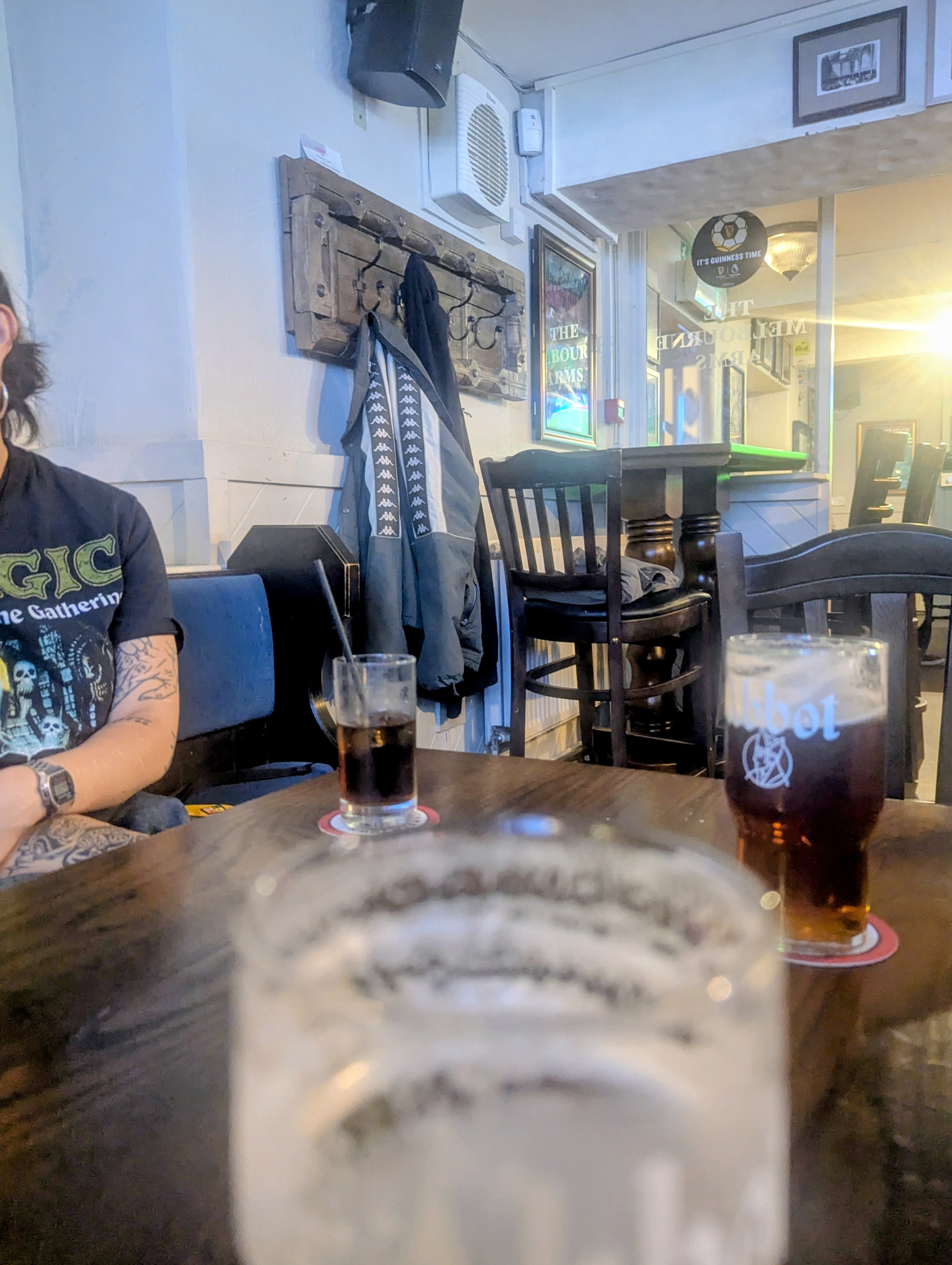
Last Friday, early evening, I met my wife in the Roebuck, a recent acquisition by Joseph Holt, which has since been extensively and expensively refurbished. It has proved extremely popular and is the nearest pub to me. I like Joey's bitter, so good news.  It has plentiful bench seating of various types. Now, I like the room on the right as you go in. I arrived, and the place was buzzing.  I glanced round and while no tables were free, I noted that in the two large benched areas below the windows, there was plenty of room. Well, if people moved up a bit.  I ordered our two drinks and surveyed the scene standing at the bar while waiting for E. Others were looking for seats too, and I noticed two people approach a group who were using the area on my left. There was room. They asked, "Is anyone sitting there?" and were told that there was, and they were at the bar. Not so, but the enquirers however sought solace elsewhere.

In the meantime, I had been asked "Are you all right there?" as above, despite having two drinks in front of me. Ho Hum. The other area of bench seating had two people sitting there. I should add that each area has a table or tables opposite the benches.  They were sitting opposite each other, leaving three seats to their left and around five on the window bench. To their left, a group of teachers were spread out. (I know this because they later told me.) I approached and as a politeness - as you do - said, "Is it all right if we sit here?" The male, probably older than me, said "Well you can sit there", gesturing in the direction of the teachers. Hmm. I pointed out that the pub was busy and that they were taking up between two, around nine seats, but the teachers said they'd squeeze up, and with some mutterings on both sides, the matter was left there.

Now thinking on, you often see in busy pubs, (like busy trains), coats and bags covering free seats. And these days, unlike the habit in Germany, it is unusual to see strangers sharing a table. I recall last winter, in the Commercial in London, asking a couple if we could sit at a bench, where six could be accommodated.  They thought I was asking them to move elsewhere, until I explained that I just wanted them to shift their arses along to make room, a notion that seemed alien to them.

Oddly, this aspect of pub etiquette isn't really covered much at all in t'interweb. Google is pretty well silent about it, amongst plenty of other advice about how to behave in pubs, but I'll add another point. While seated on a bench, any adjacent table is fair game to rest your pint on, unless someone is eating at that table. 

Moving on, this reluctance to share with strangers is covered by social anthropologist Kate Fox in her excellent book "Watching the English" . It pertains to public transport, but I believe also to public houses, though in that case for sure, it should be overcome.

"The Denial Rule

Our main coping mechanism is a form of what psychologists call ‘denial’: we try to avoid acknowledging that we are among a scary crowd of strangers, and to maintain as much privacy as possible, by pretending that they do not exist – and, much of the time, pretending that we do not exist either. The denial rule requires us to avoid talking to strangers, or even making eye contact with them, or indeed acknowledging their presence in any way unless absolutely necessary."

It need not be so, so here are a few simple rules to follow when encountering bench seating in a pub.

Rule 1:  Expect to share. You are in a pub. A pub is a shared space

Rule 2:  If sitting in the middle, expect to have people sit on either side of you

Rule 3: In a booth style, if sitting at the apex, rule 2 applies

Rule 4: Don't try to fill empty places with coats and bags

Rule 5: Any table adjacent is communal, unless eating

Rule 6: Be ready to hutch up

Rule7: Be welcoming and friendly. 

Rule 8: Remember Rule 1 always

So where does this leave us.  Well, if you are in a pub and someone asks if they can sit adjacent to you, your first thought should be, assuming it is possible and reasonable to do so,  "Of course, I'll hutch up a bit".  If your thoughts are otherwise, either don't go to the pub, or learn a bit of basic pub and human etiquette. It is written down for you now, so if in doubt, cut and keep.

In fact, when out in Manchester yesterday, bench seating was actually common, so maybe I have overestimated its demise. But it was mid-afternoon and quiet.

I recommend, as I have before, Kate's book. The link above is a free download.  Well worth doing, especially if you are clueless about how pubs should work.

Tuesday, 8 October 2024

Spoilt by Progress

If you look at the Banks's Brewery website, it describes, in a timeline, the various breweries taken over by the company. For most of the time the owning company was Wolverhampton and Dudley Breweries and then Marstons, and now Carlsberg Marstons Brewing (CMBC).

Back in the day, brewing companies, on the whole, took over other brewers to acquire outlets, or sometimes, to buy out an owner who wanted to cash in. The latest in the company's line was the buyout by Carlsberg of the minority share of the brewing company formed by Carlsberg and Marstons as a joint venture.  Moving back a little, Wolverhampton and Dudley Breweries themselves had acquired several breweries by takeover. These included well known names such as Jennings in the Lake District, Camerons of Hartlepool (now independent again) and Julia Hansons of Dudley, taken over in 1943. In 1999, Marston, Thompson and Evershed and Mansfield breweries were acquired. This was a now a big company, and it was renamed Marstons to reflect its national presence.  

Further additions to the company were some brewing interests of Thwaites and the former Wells and Youngs brewery in Bedford, which was bought and sold, and along the way, all taken over breweries were closed and others, too, were acquired and eventually closed.  Under Marstons though, breweries such as Jennings, Ringwood and Wychwood hung on, only to be closed when Carlsberg acquired a controlling interest.

Now the original brewery, the Park Brewery in Wolverhampton, is set to close next year. CMBC cite the lower demand for cask ale and the loss of the contract to brew San Miguel - though what that has to do with Banks's is somewhat opaque. The Park Brewery has been in operation since 1875 and its beers were once legendary in the Midlands, though much less so now.  Reading about it, it seems to be considered as a traditional brewery, with somewhat outdated brewing kit. The subsequent lack of flexibility, and the availability of additional capacity at the former Marston's site at Burton, means the writing was certainly on the wall. Nor can its value as a city centre site be overlooked.

It is almost forgotten that Carlsberg-Tetley Brewing Limited, existed from Jan 1993 - Mar 2004.  The famous Joshua Tetley Brewery in Leeds was taken over by Carlsberg Group. The Leeds Brewery was closed in 2011, and demolished in 2012, with production contracted out by Carlsberg to remaining breweries in the group.  In the meantime, they had already shut the huge Tetley Walker plant in Warrington in 1996 and then sold the Ind Coope Brewery Burton Brewery to Bass in 1998, with the loss of brands such as former Champion Beer of Britain, Ind Coope Draught Burton Ale. Although the brewery is still brewing under Molson-Coors ownership.  Tetley Bitter was farmed out to become the shadow of its former self that it remains to this day.

So, is over capacity the real reason for this? Sadly, there is little point in denying that is a fact, but the lack lustre brands produced by CMBC does not give much hope for the future either. Where does this leave us, then? In the short term, many of the large number of existing brands from formerly well thought of breweries, will be brewed on a single central site. The outcome of that will also probably mean more rationalisation in time. Choice will be diminished once again. Cask drinkers expect more than bland beer brewed down to a price that Pub Companies will pay, when they know it could be so much better. Sales will diminish further.

What can we learn from this?  The big players, all foreign owned, do not see it as their future to any meaningful extent. Cask is being further driven into being a niche product. Family and other small brewers need to fill the quality gap, though routes to market make that difficult.  

And finally,  if you want to keep your brewery alive, keep away from Carlsberg.  They have form. A lot of form. 

Supermarket bottle ranges will also likely be rationalised, and would anyone bet money that CMBC Burton has a long-term future?

Carlsberg makes the previous famous Whitbread Tour of Destruction seem like a minor blip in brewing history, and do they brew the best beer in the world?  well,you already know the answer to that.

Wednesday, 2 October 2024

Tabanko Callejón

Fuengirola in Southern Spain is a town of two parts. Towards the Malaga side is more of a resort, popular with Belgians, Dutch, and some Brits, with its attendant sprinkling of "British" pubs as well as a paseo crammed full of lookalike restaurants.  Strolling through at night, you are accosted by "propaganda" types, trying to persuade you in.  It is the sort of place that has plenty of buzz, but to me at least, little appeal, but you have to see it to be sure.  On our two visits to the town, we have probably only walked through it occasionally. There is a divide though, and when you cross it - and it is very obvious - you are in the truly Spanish part - the old town - and it is there, that for this writer at least, the real attraction lies.

Typically, a Spanish seaside old town will have a lot of backstreets, with various business, shops and of course bars and restaurants. It will usually be unspoilt and pretty well timeless. There are several squares and often these have bars with outside tables of  varying degrees of appeal and sometimes, hidden away, is a gem. Such is Tabanko Callejón. Situated on the main road, opposite Pl. Reyes Católico, a busy square which contains a very smart hotel, the former Town Hall, at its top end. I know this, as this is our hotel of choice when we visit. You could easily miss the bar, next to a supermarket, with an unassuming exterior. It is a proper Spanish bar. Proper in that it almost solely attracts locals and that it ticks every box in the mind's eye of what a Spanish bar should be. It is typically rammed during the day and then, not evening, is the best time to visit if you want the full on experience.

On our previous visit, we had sort of looked in several times, balking at the merry din and wondering, "Are we welcome here?" Once we had actually gone in, and as we couldn't find a single place to stand or sit, we retreated, self-conscious, tails firmly between our legs and utterly defeated. We had also looked in at night where it was a shadow of its daytime self, less busy, more gloomy and somehow not the same.  This time our hotel room, with its little balcony, overlooked the square and the bar. We could watch the comings and goings. We needed a plan, but we were going there no matter what.

We decided on simplicity. Basically, we'd get in there in good time and make ourselves part of the furniture. So, on the appointed day, we'd have a small breakfast, go in early afternoon and eat lunch there. The bar is quite long and thin, and we speculated that we'd be looked on more kindly when taking up one of the few tables if we were eating. 

When you enter, the first thing that strikes you is the hubbub. The air crackles with shouts and laughter and while it is quite dim, you realise instantly that this is the real deal. The place is going like a fair and is just as cheerfully boisterous.. On the right are a few empty, more formal tables, all with cutlery and all with reserved signs on them. The bar takes up the length of the room, with a few high tables and wine barrels acting as tables facing it with stools for seats. There isn't much room between barrel and bar. Just enough to get by. At 2pm, all except one are occupied, while the bar is crammed with bodies, some with small plates in front of them, some not, but all with either a caña of beer, a vermouth, or a glass of wine.  We boldly nab the only empty table as we look round.  Within seconds, a waiter approaches with a brief hello. Are we eating, he says. We reply in the affirmative, he asks what drinks we want and disappears. Dos cañas. He brings two Cruzcampo and plonks them down with a menu. Seconds later, he returns with a plate of bread and a small bowl of paella. "On the house" he says. We are in and can relax.

The theme of the bar is bullfighting. The walls are decorated with the heads of vanquished bulls, looking, presumably in their taxidermized state, a lot more happy than when they met their fate. Bullfighting apparatus covers the ceilings. The bar is dark brown and white walled, with the usual trinkets, bric-a-brac and collectables, and at one end several large wine barrels are dispensing who knows what.  On the door end of the counter is a chill cabinet with salads and seafood. A cheerful pile of knobbly and oversized tomatoes completes the picture.

Looking round, there is a good customer mix. Mostly men or couples, but this changes as a family come in and occupy the reserved tables. They are jolly and have various children, obviously used to it all, who are fussed over and included.  They don't run around, not that there is any room to do so. Behind us is a man in his thirties, accompanied by a younger woman. He is the type that you certainly wouldn't want your daughter to bring home, and they spend their time canoodling, though in fairness, he is the canoodlee rather than the canoodler.  A barman catches my eye as he shucks shellfish with a fierce looking knife, without looking at them. He jerks his head to the couple and shakes his head at me. I shrug and nod. We understand.

You wouldn't really have thought the bar would get much busier, but it does. The dynamics are simple. Newcomers try to squeeze in, or wait just behind those at the front, and when someone goes, they seamlessly slide in. Our server brings our food all at once in the Spanish manner, but as two of our three plates are salad - no problem. We eat boquerones and move on to white verdejo wine while taking it all in. Measures are generous and only three euros.  I raised finger gets you a refill. It is all easy now. My barman friend - a worried father maybe - catches my eye again. His feelings now quite open about the couple behind me.

A single woman enters and skilfully finds a spot in front of the tomatoes. She acknowledges everyone around her and throws us a winning smile. Children, old ones, locals and foreigners, everyone is welcome if they play by the rules and really, all you have to do is read the room and tune in. We are happy and our food finished and enough wine for now, we depart.  As I look back, "our" table is occupied already. No doubt it had been subtly watched and earmarked.

So, when in Spain, find these places. They are so worth a visit and a people watcher's paradise.  The atmosphere is unbeatable and the experience lasting. Don't be afraid of them.

We also had an afternoon in Torremolinos as a trip out on the Sunday of our week away. Though not in the same league as Tabanko Callejón, we found a couple of excellent traditional bars, including one, surprisingly, in the main shopping Street. Well worth looking in the backstreets anywhere in Spain really.

Spanish Cruzcampo is pretty easy going stuff. Maybe the best, but Alhambra and Victoria are OK too. San Miguel and Mahou, not so much,  but you may think differently.


Thursday, 26 September 2024

What Would You Have Done?

 I wrote sometime ago about the relatively recent phenomenon of queuing at the bar.  You know the kind of thing, standing in a line rather than joining a general scrum in front of the bar. Proper pub behaviour, in other words.

On return from our week in Spain, we decided to stay a couple of days in London.  We'd flown from the fab London City Airport, which was way cheaper for similar times than flying from Manchester, and comparatively a lot easier to get to given our London flat is dead handy for the Docklands Light Railway.  The landing at London City is quite an experience, and I'd recommend it, but I digress. Once we'd settled down and sorted this and that out, a pint seemed, as it usually does, an excellent idea. 

We had returned to rather pleasant weather, so cheerily set off, me still in shorts and a tee shirt. Our destination, as it almost always is, was the excellent Aldgate Tap.  OK, it is a bit modern, but I know the manager (and the owner) and it is well run and with, for London, decent prices and excellent German beer.  It is set in a square with a fountain, lots of outside seating and, being London, standing room too, but we always sit inside to avoid the inevitable smokers and now, vapers.  The pub - well a bar really if truth be known - has rather a small actual bar - probably not much more than 10 feet (ca. 3 m) long -  with all dispense being from taps on the wall. There are no fonts or pumps on the bar itself.  We walked straight to the bar, like you do, chose our beers and found a comfy low level seat - as I get older, and with my new knee, I don't really enjoy the high perch of bar stools quite so much.

The manager came over for a chat, and we sat happily afterwards with minds in neutral, just passing the odd remark.  Three quarters through our drinks, I asked E if she wanted another. Be prepared and all that. She replied in the affirmative and then said something I wasn't expecting. "You might have a bit of a wait - have you seen the queue?"  Somehow I hadn't noticed, but a queue had spontaneously formed and was now snaking out of the pub itself and well into the square. It was work chucking out time, a warm and sunny day, and the queue was being extended before our eyes as more punters joined it. I was taken aback.  This was a dilemma I wasn't expecting.  I watched and though the bar staff were making valiant efforts, the line was not diminishing. It would clearly take some time to get to the front of it, and our glasses were nearly empty.

Now, as I wrote in my earlier piece, I don't approve of queues in pubs, but this one had been organised by the customers and the dozens of people were patiently waiting their turn. E asked if we should go somewhere else, but that seemed like a defeat. Now if it had been a long traditional bar, I'd likely have just ignored the queue and walked straight to the bar, but that was totally impractical here. The bar isn't big enough.

With a heavy heart and great reluctance, I walked out of the pub and joined the tail end of the queue. The British penchant for queuing had, on this occasion at least, beaten me into conformance. Thankfully, by the time we had our third and final drink, the queue had gone. 

I am relieved that in my previous piece, I didn't nail my colours too firmly to the mast. Do circumstances alter cases? I think so, but I didn't feel great about my compliance with it.

It should also be mentioned that there are usually two good cask beers on offer at a touch under a fiver a pint. Not so common in central London these days.

Tuesday, 24 September 2024

The Grauniad Needs a Pint

There has been a bit of a stooshie recently, following the Guardian - without consulting anyone meaningful about the matter - suggests that we'd all be brighter eyed and more bushy tailed if we gave up pints in pubs. We should replace them by two third measures. Well? Really? Is this so?

Reporter Elle Hunt - me neither - is all in favour of it, so that's good at least. In what would best be described as a puff piece, she quotes as follows: "Researchers from the behaviour and health research unit at the University of Cambridge have recommended that the traditional British pint be abandoned in favour of the two-thirds measure.

After a trial in a dozen pubs, bars and restaurants in England, the study leader, Prof Theresa Marteau, concluded that the change – which led to nearly 10% less beer being sold and consumed – could reduce the impact of alcohol-related harm."I’m entirely in favour of the idea", says Elle, so we really should take a bit of notice, shouldn't we?  Well, no.

The Prof quoted is worried about heath. We drink too much don't we, so forcing us into drinking in smaller glasses would decrease beer sales, by 10%. Well with 50 pubs a month closing, that would certainly speed things up if that's your aim. The likely outcome wouldn't be good for the consumer either, It is likely, nay certain, that the outcome would be shrinkflation with the same being charged for less. And of course, home drinking, where most of the real harm occurs, would not be affected. Didn't spot that one Prof? We'll come back to you later.

However, Elle, isn't worried about that. She lists her reasons for disliking the pint.  This is now serious stuff. It is too big; it is unwieldy; you get bloated; the beer gets too warm before you get it down your neck; one intended pint usually end up being two, forcing you to drink over a litre of beer. How awful. This is compounded by this fatuous remark "Really, when you think about it, 568ml is an obscene amount of liquid to consume in one sitting – and 1,136ml even more so. It probably wouldn’t occur to you to drink more than half a litre of coffee, or milkshake, or kombucha at a time. So why is it the norm, in Britain, with beer – and despite the known harms?"  So there you have it. Obscene to drink over a litre of beer.

Elle tells us - she's Australian it seems - that in Sydney the schooner (not the same as two thirds actually)  is the norm and is widely accepted. I've got news for her. The pint, from my recent experience, is widely accepted too. In fact, in all the pubs around the harbour area, it was standard, though schooners were available. It was pretty much the same everywhere and though it varied from state to state, I don't recall many occasions where it wasn't available. 

If the argument is that two thirds measures should additionally be available, I wouldn't have much of an issue. Here in the UK, two thirds measures are pretty much confined to the craft beer sector, where strength is more likely to be higher. Normal pubs - and I use the word as a delineator, simply have no call for them, and it can also be argued that two thirds is a good way of disguising cost.

I've not forgotten the Prof whose team determined that if you give smaller measures that you sell less beer. (I think even the most casual primary school student of arithmetic could work that out.) Most beer in pubs though is used as an agreeable social lubricant, rather than something to get trashed on. If that's your aim, there are cheaper and quicker ways of doing so, rather than expensively necking pints of (mostly) weak beer. But the danger in all this nonsense is that it deflects from dealing with the real issues of alcohol abuse, which is, for those affected, absolutely dreadful.

Funnily enough, this daft piece has attracted much radio and other media attention. I have seen little support from subsequent public comments, though there have been some silly comparisons (small glasses in Düsseldorf for example) and many vacuous arguments, but such things are easy airtime, so we shouldn't be surprised. 

This is a fatuous article. Clickbait more than anything.  As Elle herself says, the pint has been around since 1698. I'm not for a second saying there isn't a problem, but is beer and the pint really the issue here? Let's just leave it alone and concentrate on tackling where real harm occurs, that is in unlicensed premises, like our homes and the social and political issues that surround alcohol abuse.

Oh, some stats about the UK and alcohol for perspective: 

UK is 27th for beer consumption in the world, with 67 litres per head of population. Well behind the leader, the Czech Republic, with 188.5 litres.

We don't make the top 15 for alcohol consumption in the world and, though I couldn't find exactly where we rank, we would be 18th in the EU if we were still in it.

We are 69th in the world for deaths attributed to alcohol, with 1.76 per 100, 00. (Germany is 25th with 4.32.)

Update: A more serious piece was published in the Guardian here today. It covers much of the ground I have covered, and features sensible stuff by Roger Protz and Pete Brown, but I've written this now, so here it is.


Tuesday, 2 July 2024

Wot I Wrote Nearly Thirty Years Ago

I've been at this old beer writing game for a long time, which is likely why I don't do it nearly as much as I used to. Thanks to the What's Doing archive, though, I can sometimes be reunited with stuff I wrote way back when I were a lad. What is (painfully) reproduced below, is one of these. 

When I say I have been banging on about the Beer Orders for a long time, I really mean it. I may have mentioned them before this article, but I don't know for sure. Suffice it to say, this blog has moaned about the law of unintended consequences resulting from this fateful legislation, more than once. 

So how right or wrong was I? Well, let's go through it. Well, Tetley-Walker and Boddingtons, the subjects of the title, have gone completely as companies. In the case of Boddingtons, their beer, a shadow of its former self, hangs on as an unloved canned brand of AB InBev. Tetley-Walker has vanished forever, its brewery long since demolished along with that of its erstwhile partner, Joshua Tetley of Leeds. Tetley Bitter, as iconic as Boddingtons in its day, still exists as a cask beer, now contract brewed by Camerons in Hartlepool. Whitbread, who bought Boddingtons has more or less vanished from pub game and certainly has from the beer business. Greenalls have gone too, turning up their toes in an act of self-destruction, though they saw it as a grim and impossible future which my article predicted. Morlands, also mentioned as vulnerable, have long since become part of the all encompassing Greene King and live on, only as an afterthought in GK's brand portfolio.

I predicted, too, that "We cannot expect anything other than a contraction of choice from the big suppliers, be they brewer or pub chain. At best we can expect a collection of tired old national brands brewed down to a price, at God knows where."

Sadly, my all seeing eye wasn't perfect. I got the demise of Vaux right, but didn't see that Greene King and Banks (now Marstons) surviving as well as they have, through neither in their previous form.

Still, I wasn't that far off and thankfully, despite all, we have our family brewers in Manchester surviving and thriving. I did allude to that.

I was spot on about the Beer Orders, the effects of which are still being felt today and tired old national brands, though not what they'd turn out to be. I suspect Doom Bar didn't even exist then as a regional brand.

I didn't predict the rise of the many small brewers - well not there anyway - nor the vanishing of the previous big six, but heyho, I didn't do so bad overall.


Wednesday, 12 June 2024

Having a Breather or Just About Dead?

Well, it's all kicked off again. Sort of. Cask is dead, don't you know?  It isn't nearly a flame war, so beloved of us old Usenet hands, but like any social media argument, it has the possibility of descending into one. But in reality it isn't likely to over develop into a right old ruck in these more cautious times. Injudicious remarks aren't just a punch to roll with and forgive these days, but have potentially reputational damage to hang round your neck. Back in the Usenet days, we defended our positions robustly and bugger the facts. It's what made it fun. 

What is this about, I hear you ask?  Well, beer writer Jeff Alworth, in an X post - is that right? - well, a formerly Twitter tweet, lamented about the state of cask beer in the UK thusly:

Now Jeff isn't resident in the UK, but he knows his stuff, and often, an outside view is valuable, so his comments are useful. Of course, this provoked a lot of response, as his main bone of contention, apart from cask dying on its arse, is that it needn't have been so. If only these silly buggers in CAMRA had accepted the use of cask breathers (aspirators) long before they actually became neutral on the matter. They therefore didn't care about quality. His blog on this is here:

So, what is a cask breather, then?  Wikipedia describes it well:

A cask breather (sometimes called a cask aspirator) is a type of demand valve used to serve draught beer. The cask breather enables the empty space created when beer is drawn from a beer cask to be filled with carbon dioxide from an external source. This prevents ambient air from being drawn into the cask, thus extending the life of the beer by preventing oxidation.

To avoid carbonation of the beer, the carbon dioxide gas added by a cask breather is at low pressure, unlike the high pressure gas used to pressurize keg beer. Cask breathers are typically used in conjunction with a pressure regulator to ensure the gas pressure is sufficiently low.

Before 2018, the use of cask breathers was opposed by the Campaign for Real Ale (CAMRA), a policy that was changed in April 2018 to allow pubs using cask breathers to be classified as real ale pubs and listed in the Good Beer Guide.

Now without getting too technical, that'll do for now, but one caveat. Oxygen gets into beer before the  cask is vented, so the demand valve isn't a panacea. It just delays the inevitable for a few days depending on many other external factors, such as handling in the pub cellar, and care in the brewery. Maybe in a limited set of circumstances, cask breathers might have helped, but overall, would it really help the trade to prop up the ailing patient, cask conditioned ale? In the view of this writer, it most certainly wouldn't.*

So, what about the next contention, that cask ale is a dying beast.  Here we have the possibility of a certain amount of disagreement, with cask aficionados planting flags firmly in the "No" camp and in fairness, in the X arguments, few actually claiming that it is in rude health.

Well, where are we really?  In sheer volume, cask is a declining segment of the market, but there are many variations. In many cities, finding good to excellent cask beer is not a problem. In no particular order, I'd suggest that applies to:Manchester, Liverpool, Leeds, Sheffield, Hull, Chester, Wolverhampton, York  - and likely Bristol and Norwich. This list is not definitive and the bonus is that usually, the quality of beer in the surrounding areas is also dragged up by proximity.  Even London is showing signs of recovery, with my own experience of  recent improvement and many defenders springing to its aid on X.

When it comes to cask and point of view and credibility, you can, if you are so inclined, safely put us long in the tooth veterans, in a box labelled "Old Farts". This can then be filed away where you'll never find it. However, there are some younger types who have seen the true light more recently, who can provide a more up to date perspective. Beer writer Matt Curtis, while always a cask drinker among other stuff, is now, since relocating to Manchester, where cask is still doing well, seeing the role and position of cask from a somewhat different perspective: 

He says on X in the same debate; "as someone who spends a lot of time in pubs around the UK, I’d say that cask is not on “life support” but is actually thriving in its pockets.”

Another cask devotee, ex Fullers Head Brewer, John Keeling subscribes to the view that cask is a niche now and that is probably correct. It is no longer a mass volume product in the way it once was, but it is still a substantial niche and even, in some places, still mainstream. 

Sorry Jeff. Cask beer isn't on life support, but increasingly being seen as something that, if done well - and that is what is happening - will have discerning drinkers seeking it out. Volume may have gone, but its innate quality and sheer drinkability will ensure it survives and is sought after, albeit by fewer numbers. And, from my point of view, it will see me out, so that'll do!

*Breathers are almost never used in areas where cask is thriving and viable and never have been, so go figure. I'll contend that while breathers would have saved the odd marginal outlet, they would never have helped against lowest common denominator beers in "couldn't care less" outlets run by big PubCos. It is wishful thinking to my mind, evidenced by the fact they are still so rarely used.

The demise of cask as a mass-produced and volume consumed product has been a long and tortuous one. Mostly stems back to the Beer Orders, but that is another post. There are some great contributions to the debate on X. You could also read this venerable, but relevant article here: https://tandlemanbeerblog.blogspot.com/2013/06/where-did-all-money-go.html