Showing posts with label Opinion and Comment. Show all posts

Saturday, 23 August 2025

Munich Observations Part One

Back from a few days celebrating my birthday in Munich, I couldn’t resist jotting down a few thoughts about my favourite city — one of Europe’s great beer capitals, most at least, would say  — and how it’s changed since I was last there five years ago.

First off, we struck gold with the weather. From the moment we landed until the moment we left, the sun shone gloriously. That felt like a jackpot, especially given how grim the weeks beforehand had been, as we'd noted from various weather sites before we left. As an aside, I’ve been in Munich when the Alps pull in the clouds and leave you with nothing but drizzle and grey skies that seem to sit there forever. Not this time. This time it was beer garden weather, pure and simple. What we came for.

So, what’s different since my last visit? The biggest surprise: cash is no longer king. Germany has always been the land where a pocket full of notes and coins was essential. But now? You can get by almost entirely on cards. Even Munich’s MVV transport network is on board. No more trying to work out which way to insert the euro notes.  Granted, their ticket machines remain as clunky and unintuitive as ever though the newer ones aren’t quite so bad, but with patience and pressing the English translation, you'll muddle through. Not at all cheap though since they abolished the Partner Tagescarte

In pubs and restaurants, cash is still happily accepted, but plastic works just as well. The interesting development is tipping. Traditionally not much of a thing in Germany, but now you’ll often be asked — politely, even a little awkwardly — if you’d like to add one. Five to ten percent seems to be the going rate. It’s not quite expected yet, but you can sense the shift. That gentle, apologetic ask will no doubt harden into a norm before long and as for five percent, well, that will go too, but you can always decline. Or pay more.

And what about prices? They’re a mixed bag. The good news is that Augustiner, still widely considered the city’s best beer, remains among the most reasonably priced. Quality and value is always a winning combination to enhance any drinking experience. Expect to pay under €5 for Augustiner, but more in most other places. 

I don't think anyone would disagree that the most commonly purchased beer in Munich is Helles, so let's go through the card. Here we are, brewery by brewery, in order of the quality of the Helles beers that I drank:

In reverse order - that is worse first:

Hacker Pschorr: Dull, sweetish with some good malt characteristics. The head disappears without a trace, and the beer itself is pretty underwhelming, leaving you with the feeling that something is missing. 

Spaten:  A very appealing light bronze colour and appearance, but this beer has no zing.  Dryish, thin, and again head retention stinks. No real hop presence. Drink it quickly for best results.

Paulaner: Middle of the bunch. Less sweet than HP, its stable mate, but despite an appealing biscuity malt nose, it is rather thin and underwhelming.

Loewenbrau: Decent beer with a good mouthfeel, a fresh flavour and a slight hop finish.  Again, drink it quickly to get the most enjoyment. 

Hofbrauhaus: A step up in quality. Good biscuity malt, some peppery noble hops just about say hello. Better head retention and overall gives an impression of a well-made beer. 

Schneider: Very decent helles, which ticks all the boxes. Malty and slightly sweet with a touch of peppery hops. An easy-going quaffer with some character.

Ayinger: Clean, golden beer with a more steely backbone and a fuller body. Usual biscuit / bready notes to a clean, slightly herbal hop finish.

Tegernsee: Dry, clean and crisp with some bready malt. Gentle hop finish. Satisfying.

Augustiner; Fresh straw coloured beer, some hop nose and presence, good body with fresh malt notes and floral hops. Balance is much better here in this refreshing beer. One isn't enough.

Of course this is just my opinion and nearly all make a reviving drink on a hot day. Head retention was poor in most and all would benefit -  at least in eye appeal - from etched glassware, but again, that's just opinion. I like a head on my beer.

I would say that Augustiner was the winner by quite a distance. There is just something about the beer that sets it apart. 

Next I'll discuss pubs, beer gardens and weizenbier.

Oh and the best beer by a considerable distance was Augustiner Pils, which E drank when she could. Bottled only and a cut above Helles in my opinion.  An honourable mention goes to Augustiner Edelstoff.


Friday, 14 March 2025

Northern Restaurant and Bar

On Wednesday I attended what is described as "The North's leading hospitality trade event. Bringing together over 9,600 visitors and 300+ exhibitors".  This is an annual event and I have been going, off and on, for quite a few years. The venue is Manchester Central, the huge exhibition centre formerly known as GMex and renamed after the railway station it used to be.  It was fitting that my companion for the day was my friend Graham, with whom I co-organised the Manchester Beer and Cider Festival  for several years when it was held there. It felt like a sentimental return for both of us.

We went on the second day of this two-day event, mainly to see who we knew - usually many - from both publicans and local breweries - and as always to have a chat with the various other exhibitors -  and certainly to sample a few beers. Firstly we had a look round to get the lie of the land, and, knowing the place as we do, we both felt that the exhibition was using more of the space than previously. This is a good thing, because the event is popular and can be very crowded. It is broadly split along the lines of food on one side and drinks on the other, with trade suppliers of everything from cutlery to glasses and electronic tills all dotted around and a central "theatre" where presentations and discussions take place. 

This being the second day, it wasn't too manic, but apparently, on the previous day, it had been rammed and there were a few slightly pissed people. Even small samples of spirits, will, I suppose, do this if you have enough of them - and there were plenty of these to go at -  but everyone I knew was very well-behaved and indeed I saw nothing untoward at all. In fact, the event was very civilised and well organised too.

Our first port of call, by accident as much as anything, was the bar of La Chouffe, owned now by Duvel Moortgat brewery group. A quick taster of  Cherry Chouffe  warmed us up in more ways than one with its 8% alcohol and as a bonus, we were both given a souvenir glass. We tucked that in our coats and set off for pastures new, being stopped on the way by a rep offering a free can of beer. Ah. No bag, so a detour to the Lipton's Ice Tea bus, saw us sorted out with a tote bag for any subsequent offerings.

I decided that my tastings should have a purpose. I'm fond of nitro stouts and there seemed to be a few on offer, so I'd try and taste them all. A benchmark need to be set, so I plumped for a beer I know. So, off to JW Lees stand for their excellent stout - which is not, strictly speaking, in the Irish style - followed by two from Theakstons.  They offered Brennan's Irish Stout, which was rather sweet and chocolate forward, but with a little late bitterness. The other, Barista Stout was as expected, big on coffee and vanilla, but overall, a bit too sweet for me.

Next up was another local one. Joseph Holt's Trailblazer Stout, a beer, again I am familiar with. This is more Guinness like, and I enjoyed its tasty roast malt and its chocolate and slight smokiness. A very well-made beer.  I also gained a bit of intel about a licensee change in my area, so a bit of CAMRA business too, though I was badged up as a "Beer Writer".  A new one for me though was Coal Drop from Tiny Rebel. A joint venture between distributor LWC and the Newport based Tiny Rebel, this was an absolute beauty.  The lads behind the bar couldn't have been nicer and the beer was excellent, with a silky body, a touch of roast malt and a smooth finish. Excellent stuff.  

Final two were Brock from Thornbridge which was a little disappointing, being a tad thinner than the others and finally, BrewDog Black Heart, which was decent, but seemed to lack flavour.

So, there you have it. I must point out that all stouts were served in sample sizes of a few ounces, in various plastic "glasses", so you have to bear that in mind, though some were sampled more than once. To me the Coal Drop just edged it from Lees Stout, but I do wonder if they were tasted blind, in pint glasses, how it would all have turned out.

I wasn't alone in my stout interest, as you could observe many people asking for samples. One thing seems certain, the stout revival continues apace and I reckon we'll see a lot more brewers putting efforts into promoting it. 

Other highlights were, as usual, seeing people I know and meeting brewery staff. A special mention to Iain from Greene King who was a smashing lad, and to everyone else who represented their companies with charm and good humour, despite their sore feet.  It was also very gratifying to hear that many had done great business there, including some of the smaller breweries exhibiting.

I did also sample various other beers as we went round. Top of the bunch for me was Swiss brewed 1936,  Birra Alpetti, a proper Italian lager and Budvar Dark. There may have been others, but it was still nice to go to the pub afterwards and drink cask from a pint glass.


Friday, 15 September 2023

Book Review - Cask by Des De Moor

The subject of cask conditioned beer is a complex and broad one and to tackle it, Des De Moor has written a comprehensive and extensive book about it. At 334 pages, it covers a wide array of beery topics, presented as a series of chapters with subject titles and a narrative about each. 

 Let's start with the introduction in which the author sets out his aims and objectives, which, broadly, are to describe the product and its history and to fill in gaps that may not be covered elsewhere. It's a big ask and a look at the bibliography and list of those spoken to or interviewed shows the seriousness with which the subject has been approached, and here is the first observation. This is rather serious book. Didn't all those interviewees have some good stories to relate as well as words of wisdom?

At the beginning of the book, the author, in his first paragraph, sets out why cask beer is "unique" and" unmatched by any other".   He concludes by quoting Mark Dorber, a cellarman of some repute, about what we'd lose if we lost cask beer, which is the joy of being in touch with something living.  These are both sets of wise words, and neatly and succinctly bookend the content between them, and are probably the most important sentences in the book.

In many of the following chapters there is an inevitable crossover to beer history and to the techniques of brewing and if you are not already familiar with the art of brewing, these will be of interest, as are the explanations of cask size, filling, returning and the many aspects that make cask beer different from keg or other beer.  The chapters on cellar keeping are meticulous in their accuracy and are recommended as pretty much definitive, though on the downside, may inadvertently give the reader the idea that cask is a much more complicated beast than it is, a possible problem if you are already inclined to think of cask as a difficult to deal with. Whatever your point of view, you will certainly learn a lot about cask beer from these chapters.

There are also strong chapters on what makes cask, cask, and cask beer styles, flavour and taste, though a tendency to over explain creeps in, for example by discussing at fair length beers that should never be presented in cask form.  (Though it is good to say that not all beer suits cask conditioning). 

Controversial subjects include unfined beer and acceptable levels of haze, but skate over the potential damage done to traditionally clear cask beer that gave rise to the doubtful response, often given to punters in the pub, "It's meant to be like that" even when that isn't so.  Rightly the effect of poor presentation is discussed and the difference between live beer and cask beer, which causes no end of difficulties within CAMRA and elsewhere is mentioned, as is the rise of craft beer and its inevitable effect on cask.  The chapters on food and cask beer outside the UK are probably unnecessary, and much of the history could do with a sharper edit. In fact, this is a theme throughout, as the book itself is probably overall a bit too long.

Moving on to recent history and the future of cask, while merger mania is discussed and the Beer Orders mentioned, there is little reference to just how far the cask beer revival had come in the late 1970s and 1980s where throughout the country, both regional brewers such as Greenall Whitley, Shipstones, Morland and many national brewers, particularly Allied (who set up separate cask chains such as Walkers on Merseyside and Holt Plant and Deakin in the Black Country) were pumping out vast quantities of cask beer. Others large brewers like Courage also produced cask in volume. With Independent Family Brewers still flying the cask flag, as they do now, the rise of lager apart, this was peak cask and more could be made of it in the book. 

Then cask beer was mainstream and most that drank it just thought of it, if they thought of it at all, as beer. Not cask beer, not traditional beer, but just beer. And peak cask continued until the Beer Orders separated pubs from brewing, with dire consequences for both cask and the beer industry; a separation which still casts a long shadow today. The author recognises this as the law of unintended consequences, but he could have expanded, to good effect, the devastating effect on cask beer production and subsequently on beer quality, the cost of a pint and much more. 

As I mentioned before, we get little by way of a look at cask beer from the consumer point of view. Where are the uplifting stories from pubs, brewers and importantly drinkers? While craft in its current form may be the younger drinkers' discussion topic of choice under railway arches, cask has always been the social lubricant of the traditional pub goer, to whom the beer is important as an accompaniment to fun, rather than the fun itself - particularly when you could simply ask for bitter, and depend on your local pub or brewery to supply you with a decent pint. What happened to these famous cask beers such as Bass, Ind Coope Burton Ale, Tetley Bitter, Boddingtons and more, that you could depend on?  We could have been told, and a few anecdotes and a bit of background would have lightened and balanced the book.

Referring to the future, there is the unanswered question that if cask is in dire trouble as production figures suggest, why does it thrive in, for example, the likes of Sheffield, Manchester, Liverpool, Derby, Nottingham - and even rural Lancashire and Yorkshire? Can we not learn lessons from them? The question is mentioned, but not explored, though one solution mooted strongly is that the answer to cask's woes is to charge more for the product. This unconvincingly overlooks the fact that brewers are the last to see much of any price increase, and that cask succeeds in the places mentioned, as do the many small brewers that supply it. Perhaps the cost of cask beer, however it is priced, is both a strength and a weakness? A dichotomy that will never be resolved?

These points, however, don't detract from this comprehensive book. It is a very valuable contribution to any beery type's library, and useful for those that want (nearly) everything they need to know about British cask beer in one place. What is perhaps missing though is the affection, romance, intensity and the human interactions that many would say is the hallmark of cask beer, but as a more serious look at the subject, it succeeds in bringing together, the technical aspects over the more ephemeral and nostalgic. 

Reviewer's note. This isn't an entirely neutral review. Where cask is concerned, I have skin in the game. After all, I have been supping it for nearly 45 years and stopped many a firkin going sour over my time.  Whatever happens to cask beer, it will see me out, thankfully!

Disclosure: My review copy of the book was supplied by CAMRA Books, from whom this excellent book can be purchased. (CAMRA Members discount is offered too.)


Friday, 15 July 2022

Banging on for Years


The Dear Old Morning Advertiser published an article today about one of my favourite subjects.  Keeping cask beer.  It referred to Greene King joining in a campaign to re-instate cask beer to its rightful place as a unique product.  The article was part of a MA initiative called the Cask Project,  "a bid to re-energise the category and reinstall it in pride of place on the bar of pubs throughout the country."

The MA goes on to say that "Cask beer is in long-time decline and, having joined forces with some of the UK’s leading cask beer suppliers – Carlsberg Marston’s Brewing Company, Greene King, Sharp’s Brewery and St Austell – we want to reinvigorate attitudes within the trade to a product which should be rightly cherished by operators." All well and good, I'd say, though they seem to be aiming this campaign at younger drinkers, who are on the whole distrustful of the product, no doubt through bitter experience of getting a bad pint and being put off for life. The points made and the laudable aims however really do apply to all us cask beer drinkers, whether callow youth or grey haired old devotees.

Now, getting further into this project of good intentions, I was very disappointed to read a rather scant set of tips to keep cask better in the pub. This, by St Austell's Trade Quality Manager, has either suffered from an over vicious edit, or is just not sharp and detailed enough to be of real use. Moving on, I won't go into too much negative comment about premiumisation, except to say that cask beer to be at its best, no matter how good the cellar  keeping is, depends almost wholly on turnover. Assuming the beer is presented as it should be,  that is the key to cask success, and it can rarely be achieved by charging top dollar for a product often served at less than its best.

One thing from Greene King's new head of brewery customer engagement, John Malone in today's piece that I thoroughly agree with though, is the statement from Greene King that "Younger drinkers aren’t choosing cask and if we can’t guarantee there’s a 99.9% chance of getting a perfect pint every time then we’re not doing ourselves any favours."  With the proviso that it applies to all of us drinkers, well said. Happily, I can report that the rest of his article which can be read here is brimming with good stuff.  I was particularly struck by the fact that new Greene King licensees are all given a comprehensive cellar management course - I wonder if the existing one are -  and the general good sense contained in the article. Logically, you now know that if you get a duff pint in a GK pub, you can refer the case John Malone. 

Finally, in this unusual peon of praise to Greene King, can I commend to you one final thing. John says; "I think there’s a perception that cask is a really difficult product to keep, but that isn’t the case. There can be a few key things that can lead to less-than-perfect quality pints being served over the bar, but if you get the basics right, it really isn’t that hard at all."

Exactly what I have been saying for years. Just have a look through blogs passim for evidence of that.

I really hope that GK and the others supporting this initiative carry on with what they are doing.  Such a campaign needs ongoing support.

I recommend to you also this fab video by Black Sheep Brewery and Maisie Adams. If you haven't seen it, be sure to do so. If you have, be sure to tell others about it.

Friday, 1 July 2022

Two Fab Pubs

 I had a couple of pints with an old mate of mine yesterday. As this was to be an uncomplicated affair, we met outside the Lower Turk's Head in Shudehill, at my request. You see, I rather fancied a pint of Joseph Holt's Mild and there it is sold. Now the LTH is a fairly recently acquirement by Messrs Holt, and it has been done up rather traditionally, and rather well too, in my opinion.  Of course, such makeovers and purchases must be funded, therefore it is by no means cheap by Holt's standards. In fact, a pint of mild was a rather pricey £3.95. This for a 3.2% beer. Oh, well. The weather was decent enough and as we supped and chatted, we watched the comings and goings of the bus station opposite, and the many passers-by. The beer was in excellent condition and the outside eating conducive to contentment, so to even things up, we had another.

Now just a few doors away is the much adored Hare and Hounds, one of the finest traditional pubs in Manchester.  No mild on there, but Joseph Holt's fine bitter at a mere £2.90 a pint. A not unwelcome saving of £2.10 a round. This was in even better nick - in fact remarkably so given that the mild earlier was no disappointment, and we enjoyed a few pints together in the company of a fellow CAMRA worthy of our long-standing acquaintance, who had just popped in for one.  Service here is swift and friendly, as indeed it was in the LTH.  Now, what point am I making? I'm not really sure, but I suppose it is that a quirk of free versus tied trade pricing, allowed us to drink Holt's beers much more cheaply than in an adjacent Holt's house.

So which did I prefer? Beerwise? The Bitter was superb and the Mild not far behind. Pubwise? Well, possibly the Hare and Hounds, as it is the kind of pub that is all too rare these days - a simple drinking house - unchanged, and none the worse for that - even on an afternoon sans geriatric cabaret.* But don't let the price put you off drinking Holt's Mild or other fine Holt's beers in the Lower Turk's Head.  It is all good stuff, and it's a smashing pub in its own right.

In fact, go to both. You won't regret visiting either one.

We watched some shocking and blatant littering too. Some Manchester citizens should be ashamed of themselves. My companion shouted at them to no avail, but at least nobody stabbed us.

Factoid. Within a five-minute walk from there, you can sample beer from all Manchester's large brewers - Holts, Hydes, Lees and Robinsons. 

* Enquire within.

Tuesday, 29 March 2022

High Standards. Still Paying Off

When asked about how a pub can make the most of itself, I usually paraphrase Bill Clinton, who when campaigning for President, when asked the most important thing about governing America answered "It's the economy, Stupid".  My paraphrase is, "It's the offer". I don't add "Stupid" though. Well, not generally.  

You would think it obvious that when running a pub, the main consideration would be how best to present the pub to attract the maximum number of customers of the desired type wouldn't you, but amazingly, to this writer at least, that often doesn't happen.  That isn't wholly  the point of this particular piece, though, but it does show the value of getting it right.

The Swan with Two Necks in Pendleton was the CAMRA National Pub of the Year in 2014.  It is a neat little place near Clitheroe in the village of Pendleton. Slightly off the beaten track, but well worth the small detour, if like me, you are on a coach that is going to Clitheroe anyway.  I was with my fellow imbibers from our CAMRA Branch and in the time-honoured fashion we were due at the Swan, by arrangement, shortly after opening time.  There were, I think, about forty of us on the coach and our social guru had arranged in advance, for those requiring it, a lunch of sandwiches and chips.  We'd opted out, as such an early lunch was not needed, but after the warmest of greetings and pints being selected -  we were shown to a marquee in the garden where (for a fiver a head) a veritable feast had been laid out.  This was quality and worth every penny, judging by the oohs and aahs of the participants.

The bar staff, in what soon became a very busy pub (apart from us) were fantastic. They dealt with the thirsty influx with cheerful calmness and control and somehow, we were all served very quickly. The beer range - see photo - was an absolute delight and was immaculately presented, while the landlord and landlady oversaw it all with smiling efficiency.  I recognised the boss, Steve Dilworth, as shortly after the award in 2014, I'd visited the Swan and interviewed him on behalf of the On Trade Preview magazine, for whom I'd been commissioned to write an article on what made an award-winning pub.  I wrote then, "Steve runs a pub that works for him and his customers. He exudes the warmth and welcoming attitude that you hope for in a pub, but don’t find often enough.  If you had to sum up his offer, it is a balanced one that has evolved rather than been devised. At the Swan you get a genuine welcome, good beer, good food (in generous portions) and a pub which is the centre of the community. It goes without saying that the beer is above reproach in its quality and condition." 

It was good to see that almost eight years later that same warm welcome and high standards were still there for all to see. I think it's fair to say that many of us, despite the attractions of Clitheroe, would have stayed there all day. And you can't really have a much higher compliment than that.  We all left with a degree of reluctance, with Steve thanking us and coming out to wave us off.  

The line-up of beers was particularly well-chosen.  But what a dilemma. White Rat, Harvey's Best and Fyne Ales Jarl. How on earth do you pick the bones out of that when you only have limited time?

 I won't do a pub crawl report of Clitheroe, but it is well worth a visit, with a few decent micropubs, the massive Bowland Beer Hall and to me, the pick of the bunch, the New Inn - a proper old-fashioned pub with a great range of beer in top condition.


Wednesday, 9 March 2022

Ask Not for Whom the Bell Tolls

There is quite a lot of unseen business in campaigning for real ale.  I know many view the organisation as  merely a glorified drinking club, which, of course, to an extent it is, but there is much valuable work done behind the scenes in the vital area of information gathering.

It is a priority of our Branch to update all the information for the large number of pubs we have in our area. That will mean that the drinking public that use WhatPub - CAMRA's national database of pubs  - will have the most up-to-date information possible. While we try to keep everything as recent as we can, we do tend, naturally, to concentrate on the real ale pubs and clubs in our area. As a matter of interest, we look after approximately 350 pubs and clubs selling real ale across the boroughs of Rochdale, Oldham and Bury, with funnily enough the three areas all have a third or so each. Despite our 2100 members, as you can imagine the task of updating, falls to a few dedicated souls.

Thus, it was I found myself checking up on a long-standing real pub that had been reported as reverting to keg only.  This is a pub that was first a beerhouse in 1860 and only became a fully fledged public house in May 1960.  I rather think that in all the time it has sold beer, it has been sold in either bottled form, or more likely,  as cask conditioned real ale.  Alas, no more.  A very amiable chat with the landlady revealed that she switched to keg on re-opening after Covid-19.  I expressed surprise and with a pained expression she explained, that put simply, over the years and exacerbated by Covid, most of the bitter drinkers had died off and not been replaced. This had resulted in her having to throw away rather a lot of beer. Over time, with no improvement, she realised that she simply couldn't afford this, hence the move to the smooth version.

Looking around me in this neat little street corner local, there were, perhaps, a half dozen people around the bar at 5.30 p.m.  All were drinking pints of lager.  I sympathised with her predicament, and she assured me it was a very reluctant step and maybe one day, things will change.  I replied that I hoped so and left. She was a smashing woman.

There used to be a pub like this on almost every corner, but things have changed so much, that this is no longer the case.  Bigger, brighter establishments have more chance of survival these days, and the corner street or mid-terrace local, where everyone once went, is struggling.  Are bitter drinkers getting older? Well, of course, everyone is, but are these pubs that many describe as boring old men's places going to survive in any great numbers? The older customers that they rely on won't be around forever, in this kind of pub, they just aren't being replaced. Cask beer relies on volume and turnover. If that isn't there, then its presence will always be in jeopardy.

When you see so many closed little corner street pubs that used to be thriving with locals, I for one, am glad that I lived through an era that, while perhaps not the highest point of pub going, was at least when they were, more or less, all seemingly doing well. These buzzy little boozers, alive with banter and familiarity, gave me a lot of pleasure and thinking on, they still do, and I'd miss them if they all went in favour of some of the souless places they call "pubs" today.

So will they survive? It is a difficult question to answer, but looking at the evidence objectively, though some undoubtedly will, for many,  it doesn't feel that way at all.

I'm not naming the pub. That would be unfair. A landlady that made a very good impression on me is doing her best for her business.  That's exactly what she should be doing.

Yes, I do feel sentimental when I think back and when you look at the problem I outline and the people who still drink in them, you can't be optimistic.  The title of this piece tells you that I think not only will many of these pubs be gone all too soon, but those that survey and write about them won't be, relatively speaking, that far behind. 

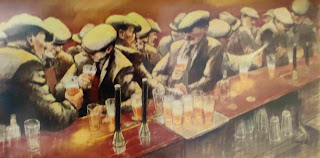
The photo is from a picture we have in our kitchen.  It seemed appropriate.

Monday, 17 January 2022

Iconic Beers Today

There aren't many cask conditioned beers that can be regarded as iconic these days I'd say. Oh, there used to be quite a few. Tetley Bitter would certainly be one of them and from the same stable, though a different brewery, who of those that supped it regularly, can forget Ind Coope Draught Burton Ale? So good that it became the Champion Beer of Britain in 1990 and a beer that if you saw it, you ordered it straight away, even if only for one pint, because it was one of those beers that was not only dangerously drinkable, but strong to boot. Draught Bass would be in there too and it, of course, despite being brewed by Marstons, still has a certain appeal. Talking of which, Pedigree could well be included.

There is probably a case to be made for certain others. In its heyday, possibly Courage Directors, or maybe Theakstons Old Peculier, but that's about it. Of course, too, some beers were legendary in their own backyard, for example, Shipstones Bitter from Nottingham, Higsons Bitter from Liverpool,  Holts Bitter from Manchester - you could likely include Bateman's XB - and many more. These though were, in the main, recognised as great beers, largely by local customers and some aficionados, while the ones mentioned in the first paragraph were much more widely available and were sought after when seen on the bar.

So what of now?  Well, certainly I imagine Harvey's Bitter would be there. Fuller's London Pride would likely be in the mix and of course, perhaps above all, Timothy Taylor's Landlord. You don't see much of Fullers here in the North, which is kind of puzzling, and rarely do you hear of Harvey's appearing at a bar near here.  But you do see Landlord all over the place. It is relatively speaking common. It also features in glowing and reverent terms on Twitter, in beer discourse, and is thought of very highly in almost every beery circle.

Me and Taylor's Landlord have a bit of history. When I first came to this neck of the woods, a local free house used to sell it. It was on the way to Tesco when we did our weekly shop, and we always stopped on the way back for a couple.  It was a rich, balance of malt and hops, with a distinctive floral touch. The term multi layered really did apply to it.  Alas, the free house was sold to Robinsons and the then landlord presented me with the Landlord pumpclip as a farewell gift. I still have it. And that was that. No more readily available Taylor's. I have supped it in Keighley too over the years and when I saw it on a bar, I always tried it. E loved it too. Of course, there is a but. Over the years, it just hasn't retained its appeal somehow. It isn't the same.

The other night, we were caught in the rain and dashed into the nearest pub. Landlord was on the bar and we ordered it. It looked great, only to taste, it was ordinary. E said, "What's happened to this beer?" I had to agree. It isn't a one off. I can't remember when I last had a decent pint of it. Landlord, from my memory, needs a bit longer to mature than most. Maybe it just isn't being given the time. I know it is often sold too "green", but I don't think that was the reason. The vibrancy and that multi layered source of delight simply wasn't there and hasn't been for a long time.

None of this is to say that Landlord is a bad beer. It certainly isn't in any way, but I accept all things change and that some memories are rose-tinted. Possibly it is just me and E, but I don't see either of us ordering Landlord automatically again soon. And that's sad, but thanks for the memories.

The Landlord pumpclip in the photo isn't the one I mentioned above.  It would take too much finding, but it is mine. The Ind Coope Burton Ale sign is my own too.

Sadly, the pub I mentioned above is no more either. It was the New Inn in Castleton. Robbies sold it for offices after a few years, which was a shame.


Wednesday, 15 December 2021

How Stouts Should Be

 Who doesn't love a good stout? Well, I certainly do, but what I'm not so keen on is those that have been extensively mucked about with. By mucked about with, I mean the addition of the likes of coffee and most of all that evil of all evils, which should only ever appear in confectionary or puddings, vanilla. To that, generally, I'd add blackcurrant - unless to disguise the cardboard taste of Guinness - and most other herbs, fruits and spices. I'll leave a slight exception for a touch of chilli, but that is a now and again thing.

It isn't that I'm against such stuff, and I agree and recognize that there are plenty out there that like these additions, but what I do dislike is that a bit too often, there isn't just a straightforward stout that tastes of, well, stout.  There are exceptions of course, and maybe too many brewers feel that a "normal" stout doesn't get them sales in a crowded market. Well that's fine, but let's at least have an unmucked about version as the default, with the additions as specials.

Others seem to agree that at least these additions should be used sparingly, as I ran a poll on Twitter with the following results:

A respectable 215 people voted, with the vast majority saying stouts should have adjuncts added sparingly and occasionally. 

This doesn't surprise me,  as that is how it should be. 

I did once brew a fantastic stout with Ramsbottom Craft Brewery. It had a hint of chilli. I did an even better one with Aldgate Brewery, which didn't, so make of that what you will.

The photo shows an unmucked about stout taken in Skipton. See previous post.

Thursday, 29 July 2021

Clearly Better

Continuing my London adventures, which, although, I shouldn't, I tend to treat as a bit of a holiday.  Sunday was again beautiful, with scarcely a cloud in the sky. It was hot, but where to go?  We breakfasted at home with tea and bacon butties and by early afternoon were ready for a stroll.  When in doubt head over the river. So we headed over the river.

It wasn't busy. On such a day, Tower Bridge is usually rammed, but in the absence of foreign visitors, we strolled over in peace, stopping in the middle to admire the view and wave to the River Police. They even waved back. I fancied some stout, but our first intended stop, the Anchor Brewery Tap, was closed for renovations, so thwarted, we made our way down Druid Street, passing the closed arch of Southwark Brewing, to Ansbach and Hobday, who apparently had a nitro porter worth having. It wasn't exactly heaving, so we bagged a seat outside and perused the beer list. The porter was duly ordered, while E quizzed the server on which of the lagers on offer was the clearest. This seemed to puzzle the poor chap and after some discussion, E chose one which she didn't think much of.  My porter on the other hand, while slightly bland at first, morphed into a very good drink indeed.

Druid Street, while not exactly dead, was as near as made little difference. The odd couple strolling; the inevitable scooter riders; people trailing obviously reluctant dogs through the heat, and the odd car and cyclist. It was all very enervating, and we sat, watching it all, in a kind of torpor. Then it got exciting. E spotted a lass with what looked like a sparkling clear lager.  As a round was due, the server was summoned. "Aha" quoth he,"That's our Pale Ale." E's hopes were dashed and the proferred taste was given a reluctant "All right".  I happily got stuck into my second pint and finally got round to tasting the pale ale. I liked it.

Following the plan, we moved round the corner to Enid Street and Cloudwater. Sadly, there was no room at the inn, and we enjoyed a couple of halves next door in Brew By Numbers. The beers were good to very good, and we left quite pleased.

The tale doesn't end there. By then, the drink wanted a drink, and we sat outside the fabulous Marquis of Wellington, an interesting former estate pub, which is now a very decent beer destination.   This is just across from Ansbach and Hobday. The beers included the Pale Ale already mentioned. I ordered it and it was fabulous. Great sweet malt, a beautifully clean distinct and balanced middle and a rich satisfying clean hoppy, finish. My beer of the trip.

I have said it before and will say it again. Clean, clear beer with distinct identifiable flavours will always beat muddy messes. Two cracking beers from Ansbach and Hobday and a smashing pub. Not a bad way to end this London trip.


We did consider Druid Street on Saturday, but I reckon that would have been unwise. Way too busy and way too hot.

I did think of my last trip to both Cloudwater and the Marquis of Wellington with Matt Curtis. I think I've just about got over the hypothermia. The contrast could not have been more stark.


Saturday, 10 April 2021

Draught Beer for the Hardy

 Well the big day arrives in less than forty-eight hours. Pubs will be able to resume outdoor selling of alcoholic drinks, though with the kind of weather expected, hot toddies or blobs might be a better bet than pints of chilled amber nectar - or indeed, non-chilled pints of cask ale. Only 14,000 or so pubs will open after a fashion and while many are booked to the seams - if an outdoor drinking area can be said to have seams  - one has to wonder how convivial such an outing will be, even if the weather stays dry. Fine of course if we have warm sunshine and/or a bit of shelter from the chilly spring winds, but that is a very debatable point. One has to wonder too if the bookings will remain as firm when faced with the reality of English Spring weather, as they were when reserved in optimism. I'm not so sure that they will.

Of course, we read too, that many of the outdoor venues aren't looking as Covid secure as they might be - though admittedly the chances of catching anything outdoors are minimal. This has been pointed out photographically on Twitter, and it does remain a concern of a kind.  I note too on Twitter that some local authorities are making up the rules of this new game as they go along, which most certainly isn't helpful. Light touch on rule interpretation seems to be beyond most Local Authorities' understanding of their role in life. It may just be chauvinism, but as a  career civil servant, funnily, we used to always be told to find ways of doing something positive. In fact one of the organizations I worked for had "Bias for Action" as one of its core values. That rarely seems to apply in the case of our local friends, but enough of my prejudices.

Another worry I have is the effect lockdown has had on peoples attitudes to spending money. We have rather become accustomed to not spending much, so perhaps paying pub prices again will be a shock to the system, especially if that dubious pleasure is accompanied by a freezing and howling gale.  This of course will apply to the longer term too, and it is to be hoped that we'll soon get used to forking up an amount for beer in an afternoon or evening, what we previously spent in a week or more at home.  Of course that will be mitigated if your home drinking has consisted of exotic DIPAs and Imperial whatevers, but for the bread and butter customer of most pubs, that won't be the case.

We have five weeks from this partial re-opening of pubs, and then we will be permitted inside, albeit with restrictions and table service. Another five weeks if that and then, hopefully we'll be free. Or will we? The future is still slightly uncertain and depends on the virus being curtailed to a minimum, while vaccinations are pushed to a maximum Talk of Covid passports continues to muddy the water and cause division and is likely to continue to provoke concerns for some time.  

Of course, I am glad that there is a start to relieving the stranglehold the Government has put on pubs and I do hope it all works. I do hope too that at least some pubs can make some money from this. My eye though is firmly on the main prize, hopefully in June, when we can all go where we want, with the minimum of restrictions.  So, only one muffled cheer from me.

Last night, with my heaviest coat on, I had a bottle of beer in the sun in my garden.  It was pleasant. But it was a big coat. Wouldn't want to walk to the pub wearing it. But I will give the great outdoor experiment a go.

I am also concerned that when pubs re-open, it won't be long until full rent is resumed. That might well see a rash of pubs failing then, as may also happen when furlough ends. There is no doubt other pitfalls along this rocky road too.

Tuesday, 26 January 2021

Brexit Moan

You will no doubt have read in the press that one of the seemingly unforeseen issues we have after Brexit is the need for a customs declaration when sending parcels to or from the EU.  This seems to be a very complicated matter indeed, as although there is unlikely to be duty paid, the amount of form filling and put frankly - buggering about - is attracting fees in addition to VAT which is payable either by the seller in the EU in the case of EU-GB, or by the recipient.  Ideally this would be paid to HMRC by the European exporter - and many will do that and pass it on in the price- but for others the game is no longer worth the candle, and they will simply cease to trade business to customer with the UK.

 Already I have seen on Twitter and elsewhere that beer is affected by this and for my own part, my occasional cases of mixed beers from Bavaria will cease for the time being. OK it isn't the biggest worry in the world as I can buy substitutes here to a certain extent, or simply buy British beer instead, which I already do.  The pity is that when travel is banned, and we are all in lockdown, a bit of a taste of Germany is a welcome diversion, but I fear that in the future, for many lovers of beer from Bavaria or Belgium, the only way to get those rare beers, will be either to pay top dollar here, if you are lucky enough to find what you want, or do without. It seems we will likely be back to awaiting our foreign trips in many cases. Here's what the German company said.

Momentan ist kein Versand nach England, Wales und Schottland möglich. Wir arbeiten daran. Aber es muss u.a. eine Handelsrechnung erstellt werden.

Danke für Euer Verständnis

 Euer Web-Bier-Team

Basically, for the time being until they work it out, no sales to England and Scotland.

My attitude, while annoyed by this being inflicted upon me and countless others was one of "Well I suppose I can be philosophical about that."  Less so when I discovered that the watch E had bought for me for my birthday in August had ceased to work.  It had been in its box more or less since then as it is a bit "dressy" for day to day use. I'd only taken it out to look at it out of boredom on Saturday, but when I did the bugger had stopped.  Like all of my watches, it is made in Germany and in this case was purchased direct from the manufacturer in Berlin. I ordered it one day and a day and a half later, UPS turned up with it. Easy peasy.

I wrote to the manufacturer complaining about the short battery life, but their response was to send me a prepaid label to send it back for repair or replacement.  Clearly they know something I don't and a mere battery replacement is insufficient. The prepaid label is also a customs declaration. It is a bit complex.  I need to know quite a few things I don't. Here it is - see what you make of it. Click to make it bigger.


Now of course I have asked the seller to tell me the stuff I don't know, but even then and with free postage I am reluctant to send a quite expensive watch back with missing information. I worry that I'll never see it again.

The beer I can sort out - or rather - live with, but my lovely watch, not so sure. Brexit dividend? I rather think not.

Yes - better inside the tent pissing out in this case.  And probably every case. Clearly business to business will sort itself out, albeit expensively, but business to customer and vice versa? I doubt it. 

And of course I didn't vote leave. I'm not that crazy.

Monday, 26 October 2020

Clubs Suffer Too

We read daily in newspapers and social media about the way the Licensed Trade is suffering under the restrictions that have been in place, in various ways and degrees of hardship, since the March lockdown.  Some geographical areas have felt the yoke of restriction much more than others, in both application and length of sentence. In the drive to be seen to do something - anything - the Government has, with regular monotony, picked the hospitality trade for particular Draconian attention, despite their valiant attempts, not only to go along with instructions, but to do so openly and embrace and improve on whatever is called for. Despite this, it could be reasonably, indeed obviously, argued that it has done so to little persuasive avail.

I will not chronicle here the damage done, not only to businesses, but lives, careers and sanity. That is all too obvious from social media and broader press coverage. Depending on your own point of view, the trade is either a potential Typhoid Mary, or a sacrificial lamb. I won't be running a poll to find out though. Suffice it to say the trade has been fighting a losing battle.

In the midst of all the rightful angst about the way our pubs are suffering in this pandemic, I was brought up sharp by a letter, hand delivered, from my local Cricket Club, of which I am a member.  While I won't give away figures too much in case they are confidential to members only, I will say that in the case of my club, the loss of income since March is now in six figures, leading to a potential loss of approximately half that amount by April 2021. If I may quote the Chairman "That is a disturbing figure in anyone's book and I urge you to take a second to let that figure sink in." 

The income has not only been lost through gate money - a small part -  but through the ban on events such as wedding receptions, birthday parties, christenings, funerals etc. Annual events such as fireworks displays, beer festivals and more have had to be cancelled.  Bar takings have been decimated.  I could go on, but it is a grim picture and one that for the foreseeable future doesn't look like improving. Of course the club is looking at a number of unpleasant but necessary measures to overcome this issue, but while not detailing these here, it is certainly a job I don't envy.

As a local CAMRA Chairman, I am always being reminded by my Clubs Officer to think about and include Social Clubs in our campaigning, which I do try and do.  Social Clubs not only provide an outlet for a lot of beer to be sold, but between them have many millions of members.  They provide a local and personal service too as social clubs, whether for cricket, bowls, brass bands or whatever as they are always membership run.  People know and depend on each other, not only for common interest, but much as in pubs, for places to meet friends and stave off loneliness. Many also sell cask beer and indeed, sometimes, are the only outlet for it in some areas. In other places, they have taken the place of closed pubs as regular places to go for a drink and meet people.

Have a think about the plight of social clubs too, when we think about the problems of pubs.  Maybe think of joining one to support it. They face the same issues and also need our support in these difficult times.

I also know there are views that pubs should be shut as we all breathe the same (possibly contaminated) air. Not sure how scientific that is, given the number of times a pub - or club - door opens and shuts and that it only takes an open window to completely change the air in a room every 15 minutes - I know. I looked it up.

Clubs are great places too to observe surviving beer oddities. I mentioned this here.  Oh and I used to be a member of the Dyers and Polishers Social Club in Middleton, many years ago. It is closed now. Bonus point if you can explain dyeing and polishing.

"Function rooms" by LoopZilla is licensed under CC BY-SA 2.0

Tuesday, 4 August 2020

Parking Tanks on Wetherspoon's Lawn


Pubs are thought in many quarters to be pretty much unmitigated doom and gloom at the moment and although there are some chinks of light, with Covid-19 still on the go -  and around for the foreseeable future - you don't expect to see many major pub openings, but there are still some.

Rochdale Town Centre is on the up. The River Roch, culverted and hidden for many years is now open again and providing a fine focal point for a revamped centre which includes a new shopping mall, complete with a cinema and eateries bang in the middle of town. OK, it leaves one, or maybe two, shopping centres rather exposed to chillier times, as footfall returns to the area around the river and the wonderful Victorian Town Hall and the tram stop.  This is a town that couldn't maintain a McDonald's in the centre and with it gone, tougher times have also seen the closure of the Royal Bank of Scotland. In the fine - grand even - building thus vacated, we now have a new pub. This hasn't appeared by some kind of surprise. Clearly this million pound plus conversion has been planned for quite some time, but equally, what exactly would appear remained a bit of an educated guess. We had heard it would be entirely wet-led. That is there would be no food, which could be considered a bit of a gambol in these times. Well, maybe, but maybe not. Either way, a substantial new public house certainly had many wondering if there is room for one more?

So what's the competition? The Greater Manchester CAMRA Pub of the Year (and narrowly beaten in the National competition) is the Flying Horse.  This as you can imagine is a hard act to follow, with its traditional beer offering, combined with real ciders, craft beer and excellent food  is clearly the one to - if not beat, that will be hard - but at least emulate.  Former National Pub of the Year, the Baum, is now under new management, but still offers a great pub experience, excellent beers of both cask and craft variety, along with great food. In the former General Post Office building, we have the Medicine Tap, selling locally brewed beers and guests together with imaginative food in a very fine conversion of yet another grand building. Bombay Brew offers a well-chosen range of craft and traditional beer, as well as Indian food of the tapas variety. It is the Bundobust of Rochdale. With the Regal Moon run by an experienced real ale loving manager who frequently tops JDWs best seller of cask ale list,  there is certainly plenty to go at. In short, for the drinker and the hungry, Rochdale, with a pretty supportive council, already offers a lot.  What can the new pub add?

It opened yesterday and your intrepid reporter, for once, not also ran, went along with the lovely E to see what was what.  The building is impressive. The outside has been cleaned up by  Amber Taverns, who operate it as part of their Hogarth's chain. The building itself was used as a house by the Rawson family from 1819, who conducted their banking business from the small adjoining building.  It was rebuilt in 1879 and redesigned in 1913 to create the distinctive porticoed frontage it has today.

Inside, once you have navigated the Covid-19 formalities and hand sanitising, you first notice the long bar to your left. Ceilings are high and ornate and original features and covings have been retained. To your right is a seating area with windows looking out onto the Butts. Behind this area, the bank’s vaults have been turned into a separate seating area. To the rear, toilets - thankfully on the ground level - are modern and appealing, as is the large beer garden to the rear.  Carpets are thick and seating a mixture of low and high. All in all, rather handsome.

All well and good, but what of the beer I hear you ask? As you might expect from Amber Taverns, the usual suspects are all here. Fosters, Carling, Heineken, Kronenbourg, Morretti and John Smith's are to the fore. For the real ale lover we have Tetley Bitter and Hobgoblin. Gin menus are everywhere and a fiver will bag you a double of some rather decent gins, as well as the tonic to go with it. Beers are very keenly priced with Tetley at a mere £2.15 a pop and Carling at £2.60. Others a tad less.  The pub was, as I'd expected, quite busy with the curious. Service was good and cheerful, aided no doubt by the Covid queuing system precluding any stress from a baying thirsty mob.

So who is it aimed at? Prices, being of an ilk, clearly indicate its next door neighbour the Regal Moon is the target. I imagine it will attract a few others too, depending on how its clientele develops.  The real ale drinker though is likely to give it a fairly wide berth, but those in need of decent gin in rather more comfortable surrounding than Spoons, might well be tempted too.

Like all new pubs, this will be a work in progress, but it will find a niche and will take business from elsewhere. New customers for the Rochdale "offer" will very much depend on the success of the whole town centre redevelopment, but Rochdale is heading in the right direction.

The Tetley Bitter retains little of its previous flavour.  As someone who drank a lot of it in my time, it isn't the same at all. Condition was average, as nobody else seemed to be drinking it.  I can also confirm there is no food offering. I didn't see as much as a bag of crisps.

There is a good recent piece on the redevelopment of Rochdale Centre here.    This gives more detail which I recommend you having a look at.

The building you can just see in the top photo, is the Regal Moon.